Today's
EarthStation1.com 15% Off Commemorative Memorial Title: Dinosaur
Documentaries MP4 Video Download 2 DVD Set
Today, January 30, 2026
January 30: National Draw A Dinosaur Day:
-- Celebrates the mysticism and magic that surrounds these
magnificent animals that once roamed the world eons ago. On this
day, kids and adults paint and sketch all types of dinosaurs -
cute, scary, jovial, wicked, e.t.c., and have fun while doing so.
On a seemingly unassuming day in 2007, a student named Todd Page
was attending an anthropology class. To relieve the boredom, he
put pen to paper and, out of nowhere, drew a dinosaur. He found it
fun and stimulating. He motivated his classmates to sketch
dinosaurs too, and they all found it to be fun. He decided to
create a day when folks could just let their imaginations run riot
by drawing the most mystical creatures that have inhabited our
planet. Todd Page registered the day - January 30 - as National
Draw a Dinosaur Day and popularized it through social media. Since
then, folks across the United States and Canada draw a dinosaur on
the day and share their creations over social media. It's no
secret that kids love dinosaurs. Ask any kid to do anything
connected to dinosaurs, and they are over the moon! Drawing is a
constructive way of engaging children. The celebrations on the day
are simple - just draw a picture of a dinosaur and post it on
various social media platforms. The picture is not essential, but
having fun while doing it is! The idea is to motivate people,
especially children, to let their imagination flow freely on paper
or canvas. Over the years, kids and adults have sketched their
perceptions and visualizations of dinosaurs and shared them
online. So, on January 30, take out your pencils, wax crayons,
color pens, paintbrushes, or even your stylus to draw your very
own version of the most mystical creature to have ever walked the
Earth. On Sale @ 15% Off Discount Till Midnight PT!
https://store.earthstation1.com/didomp4vido2.html
Today's
EarthStation1.com 15% Off Commemorative Memorial Title: The
History Of Jazz A Video Retrospective DVD, MP4 Download, USB Drive
Today, January 30, 2026
January 30: Roy Eldridge Day: -- January
30, 1911: #BOTD: #HBD! Roy Eldridge, nicknamed "Little Jazz"
or just "Jazz", African American jazz trumpet player
considered one of history's greatest jazz trumpeters -- along with
earlier jazz trumpet innovator Louis Armstrong, who strongly
influenced him, and bebop pioneer Dizzy Gillespie, whom Eldridge
strongly influenced, -- one of the most influential of all
musicians of the swing era, and a precursor of the bebop era (d.
February 26, 1989) is #born David Roy Eldridge on the North Side
of Pittsburgh, Pennsylvania. Roy Eldridge had a sophisticated use
of harmony, including the use of tritone substitutions (a now
common chord substitution found in jazz as well as in classical
music), and his virtuosic solos, which teased up, down and around
the main melody, exhibited a departure from the smooth and lyrical
style of Louis Armstrong and Bix Beiderbecke before him, and laid
the foundation of the phrenetic and staccato style of Charlie
Parker and Dizzy Gillespie who followed him. Expert in jazz, swing
and big band music, his versatility and originality ensured his
involvement with a wide range of different jazz musicians and
styles, including Fletcher Henderson, Billie Holiday, Benny
Carter, Benny Goodman, Coleman Hawkins, Ella Fitzgerald, Earl
Hines, Count Basie (who called Eldridge "the greatest trumpet
I'd ever heard in my life"), Charles Mingus, Max Roach and
many more. As the featured soloist in the bands of Artie Shaw and
Gene Krupa, Eldridge was something of an exception, as black
musicians in the 1930s were not allowed to appear in public with
white bands. Artie Shaw commented on the difficulty Roy had in his
band, noting that "Droves of people would ask him for his
autograph at the end of the night, but later, on the bus, he
wouldn't be able to get off and buy a hamburger with the guys in
the band." Krupa, on at least one occasion, spent several
hours in jail and paid fines for starting a fistfight with a
restaurant manager who refused to let Eldridge eat with the rest
of the band. Eldridge has a Queens street sign at Liberty Ave,
part of the Jazz Greats along the Van Wyck Expressway which
commemorates Queens as the home of Jazz in the 40's and 50's. He
had his home in on 109th Avenue in Hollis, Queens. After suffering
a heart attack in 1980, Eldridge gave up playing. He died at the
age of 78 at the Franklin General Hospital in Valley Stream, New
York, three weeks after the death of his wife, Viola; after
suffering a heart attack in 1980, Eldridge gave up playing for
health reasons. He is buried at Pinelawn Memorial Park And
Arboretum in East Farmingdale, New York. On Sale @ 15% Off
Discount Till Midnight PT!
https://store.earthstation1.com/the-history-of-jazz-by-billy-taylor-parts-i-amp-ii-dvd.html
Today's
EarthStation1.com 15% Off Commemorative Memorial Title: Eat The
Document (1966) Bob Dylan DVD, MP4 Video Download, Flash Drive
Today, January 30, 2026
January 30: Clothes Line Saga Day: --
January 30, 1967: "It was January the thirtieth | and
everybody was feelin' fine." - Lyric from Bob Dylan's
"Basement Tapes" song "Clothes Line Saga", one
of the songs from the legendary bootleg-come-official-release
album "The Basement Tapes", the sixteenth album by Bob
Dylan and his second with the Band. Clothes Line Saga was recorded
in October 1967, eight years before the album's release, at Big
Pink, a house at 2188 Stoll Road (now 56 Parnassus Lane) in West
Saugerties, New York. On the safety copy of the Basement Tapes,
this song was labeled "Answer to Ode", implying that it
is a parody of "Ode to Billie Joe", a hit single for
Bobbie Gentry in mid-1967 when the song was recorded; Dylan
generally parodied songs that he liked. On Sale @ 15% Off Discount
Till Midnight PT!
https://store.earthstation1.com/eat-the-document-aka-stage-3966-bob-dylan39s-1963966391966.html
Today's
EarthStation1.com 15% Off Commemorative Memorial Title:
Understanding Northern Ireland: The Historical Evidence MP4 Or DVD
Today, January 30, 2026
January 30: Bloody Sunday Memorial Day
(Bloody Sunday 1972 Memorial Day): -- January 30, 1972: The
Northern Ireland Conflict (The Troubles): Bloody Sunday (Bloody
Sunday 1972, The Bogside Massacre): -- British paratroopers open
fire on anti-internment protest marchers in the Bogside area of
Derry, Northern Ireland, shooting 26 unarmed civilians and killing
13 people, with a 14th person dying four months later of injuries
sustained during the attack. Bloody Sunday came to be regarded as
one of the most significant events of the Troubles because so many
civilians were killed by forces of the state, in view of the
public and the press. It was the highest number of people killed
in a shooting incident during the conflict and is considered the
worst mass shooting in Northern Irish history. Bloody Sunday
fuelled Catholic and Irish nationalist hostility to the British
Army and worsened the conflict. Support for the Provisional Irish
Republican Army (IRA) rose, and there was a surge of recruitment
into the organisation, especially locally. Many of the victims
were shot while fleeing from the soldiers, and some were shot
while trying to help the wounded. Other protesters were injured by
shrapnel, rubber bullets, or batons, two were run down by British
Army vehicles, and some were beaten. All of those shot were
Catholics. The march had been organised by the Northern Ireland
Civil Rights Association (NICRA) to protest against imprisonment
without trial. The soldiers were from the 1st Battalion of the
Parachute Regiment ("1 Para"), the same battalion
implicated in the Ballymurphy massacre several months before. The
Republic of Ireland held a national day of mourning, and huge
crowds besieged and burnt down the chancery of the British Embassy
in Dublin. Two investigations were held by the British government.
The Widgery Tribunal, held in the aftermath, largely cleared the
soldiers and British authorities of blame. It described some of
the soldiers' shooting as "bordering on the reckless",
but accepted their claims that they shot at gunmen and
bomb-throwers. The report was widely criticised as a "whitewash".
The Saville Inquiry, chaired by Lord Saville of Newdigate, was
established in 1998 to reinvestigate the incident much more
thoroughly. Following a twelve-year investigation, Saville's
report was made public in 2010 and concluded that the killings
were "unjustified" and "unjustifiable". It
found that all of those shot were unarmed, that none were posing a
serious threat, that no bombs were thrown and that soldiers
"knowingly put forward false accounts" to justify their
firing. The soldiers denied shooting the named victims but also
denied shooting anyone by mistake. On publication of the report,
British Prime Minister David Cameron formally apologised.
Following this, police began a murder investigation into the
killings. One former soldier was charged with murder, but the case
was dropped two years later when evidence was deemed inadmissible.
Following an appeal by the families of the victims, however, the
Public Prosecution Service resumed the prosecution. On Sale @ 15%
Off Discount Till Midnight PT!
https://store.earthstation1.com/understanding-northern-ireland-the-historical-evidence-mp4-or-dvd.html
Today's
EarthStation1.com 15% Off Commemorative Memorial Title: The Life
And Times Of Lord Mountbatten TV Series DVD, Download, USB
Today, January 30, 2026
January 30: Martyrs' Day: -- Commemorates
the death of Mahatma Gandhi, who was assassinated on the same day
in 1948. Born Mohandas Karamchand Gandhi, he is widely regarded as
'Bapu', or 'Father of the nation' in India. Gandhi, regarded as
one of the most iconic figures of the 20th century, bravely led
his country to freedom - but was killed by the bullets of violent
extremists. Indians commemorate the day by remembering his
ultimate sacrifice to the nation and preaching his values of
non-violence, unity, and morality. Martyrs' Day is observed on the
death anniversary of Mahatma Gandhi, who successfully led his
country to freedom from the British Empire. Born in the small town
of Gujarat, Gandhi studied to become a barrister and lived a
pretty austere life, until he made his first trip to South Africa,
and everything changed. Life in South Africa exposed him to the
deep class divisions of society and the evils of inequality.
Gandhi's life experiences shaped his worldviews. The
discrimination he suffered in South Africa inspired him to fight
for equality, the pain of losing his first child at the age of 16
made him a furious opponent of child marriage, and so on. During
India's struggle for freedom, Gandhi advocated for peaceful
demonstrations and inspired everyone to lead by example. He
negotiated many peace treaties with the Britishers, before giving
them the final ultimatum of departure. As the Indian constitution
came into ratification, Gandhi took on the impossible task of
building a country out of many provinces and territories. Gandhi
was vehemently opposed to the idea of partition of India. Even
after the declaration of independence, he held regular
demonstrations to establish his resistance. Gandhi's objection to
the partition was met harshly with Hindu nationalists, who accused
him of appeasing the Muslims. On the eve of January 30, Nathuram
Vinayak Godse, a notorious Hindu nationalist, shot Gandhi three
times at point-blank. Gandhi's lifelong quest for non-violence
ended with a bullet in his chest. On Martyrs' Day, Indians from
all around the world come together to celebrate the legacy of a
great hero and acknowledge the futile destruction caused by
violent extremism. On Sale @ 15% Off Discount Till Midnight PT!
https://store.earthstation1.com/life-and-times-of-lord-mountbatten-3-dvds-tv-series-all-12-pa312.html
Today's
EarthStation1.com 15% Off Commemorative Memorial Title: Mahatma
Mohandas Gandhi Documentaries DVD MP4 Download USB Drive
Today, January 30, 2026
January 30: Martyrs' Day: -- January 30,
1948: India: The History Of India: The British Raj (Crown Rule In
India, Direct Rule In India, India, The Indian Empire): The Indian
Independence Movement: The Assassination Of Mahatma Gandhi: --
#DOTD: #RIP: Mohandas Karamchand Gandhi, popularly known as
Mahatma Gandhi, Indian political and spiritual leader and activist
who was the leader of the Indian independence movement against
British rule (b. October 2, 1869) #dies when he is assassinated in
the compound of Birla House (now Gandhi Smriti), a large mansion
in New Delhi, India, by Nathuram Godse, a Hindu extremist, who
shot Gandhi in the chest three times at point blank range in New
Delhi. Godse was an advocate of Hindu nationalism, a member of the
political party the Hindu Mahasabha, and a past member of the
Hindu nationalist paramilitary volunteer organisation Rashtriya
Swayamsevak Sangh (RSS). Godse considered Gandhi to have been too
accommodating to Muslims during the Partition of India of the
previous year. Sometime after 5 PM, according to witnesses, Gandhi
had reached the top of the steps leading to the raised lawn behind
Birla House where he had been conducting multi-faith prayer
meetings every evening. As Gandhi began to walk toward the dais,
Godse stepped out from the crowd flanking Gandhi's path, and fired
three bullets into Gandhi's chest and abdomen at point-blank
range. Gandhi fell to the ground. He was carried back to his room
in Birla House from which a representative emerged sometime later
to announce his death. Godse was captured by members of the crowd
and handed over to the police. The Gandhi murder trial opened in
May 1948 in Delhi's historic Red Fort, with Godse the main
defendant, and his collaborator Narayan Apte and six others as the
co-defendants. The trial was rushed through, the haste sometimes
attributed to the home minister Vallabhbhai Patel's desire "to
avoid scrutiny for the failure to prevent the assassination."
Nevertheless, after a trial that lasted over a year, Godse was
sentenced to death on November 8 , 1949. Although pleas for
commutation were made by Gandhi's two sons, Manilal Gandhi and
Ramdas Gandhi, they were turned down by India's prime minister
Jawaharlal Nehru, deputy prime minister Vallabhbhai Patel, and the
Governor-General C. Rajagopalachari. Godse was hanged in the
Ambala Central Jail on November 15, 1949. Gandhi had ended British
rule in India through nonviolent resistance. "Non-violence is
not a garment to be put on and off at will. Its seat is in the
heart, and it must be an inseparable part of our very being,"
he stated in 1926. On Sale @ 15% Off Discount Till Midnight PT!
https://store.earthstation1.com/mahatma-mohandas-gandhi-nonviolent-revolution-biography-dvd.html
Today's
EarthStation1.com 15% Off Commemorative Memorial Title: The Story
Of Civilization: Will & Ariel Durant DVD, MP3 Download, USB
Today, January 30, 2026
January 30, 58 BC: #BOTD: Livia, Roman
empress from 27 BC to AD 14 as the wife of Emperor Caesar Augustus
(d. 29) is #born Livia Drusilla in Rome, Italy, Roman Republic.
She was known as Julia Augusta after her formal adoption into the
Julian family in AD 14. Livia was the daughter of Roman senator
Marcus Livius Drusus Claudianus and his wife Alfidia. She married
Tiberius Claudius Nero around 43 BC, and they had two sons,
Tiberius and Drusus. In 38 BC, she divorced Tiberius Claudius Nero
and married the political leader Octavian. The Senate granted
Octavian the title Augustus in 27 BC, effectively making him
emperor. Livia then became the Roman empress. In this role, she
served as an influential confidant of her husband and was rumored
to have been responsible for the deaths of a number of Augustus'
relatives, including his grandson Agrippa Postumus. After Augustus
died in AD 14, Tiberius became emperor. Livia continued to exert
political influence as the mother of the emperor. She died in AD
29. She was the grandmother of the emperor Claudius,
great-grandmother of the emperor Caligula, and the
great-great-grandmother of the emperor Nero. In AD 42, Livia was
deified by Claudius, who acknowledged her title of Augusta. On
Sale @ 15% Off Discount Till Midnight PT!
https://store.earthstation1.com/story-of-civilization-will-amp-ariel-durant-mp3-dvd-11-audiobo311.html
Today's
EarthStation1.com 15% Off Commemorative Memorial Title: The Birth
Of Europe: Ice Age To 20th Century DVD, Video Download, USB
Today, January 30, 2026
January 30, 1736: #BOTD: #HBD! James
Watt, Scottish-English inventor, mechanical engineer, chemist and
measuring instrument maker (d. August 25, 1819) is #born in
Greenock, Renfrewshire in the west central Lowlands of Scotland.
James Watt FRS FRSE improved on Thomas Newcomen's 1712 Newcomen
steam engine with his Watt steam engine in 1776, an improvement
which was fundamental to the changes brought by the Industrial
Revolution in both his native Great Britain and the rest of the
world. While working as an measuring instrument maker (known
simply as an instrument maker) at the University of Glasgow, Watt
became interested in the technology of steam engines. He realised
that contemporary engine designs wasted a great deal of energy by
repeatedly cooling and reheating the cylinder. Watt introduced a
design enhancement, the separate condenser, which avoided this
waste of energy and radically improved the power, efficiency, and
cost-effectiveness of steam engines. Eventually he adapted his
engine to produce rotary motion, greatly broadening its use beyond
pumping water. Watt attempted to commercialise his invention, but
experienced great financial difficulties until he entered a
partnership with Matthew Boulton in 1775. The new firm of Boulton
and Watt was eventually highly successful and Watt became a
wealthy man. In his retirement, Watt continued to develop new
inventions though none was as significant as his steam engine
work.He developed the concept of horsepower (one mechanical
horsepower lifts 550 pounds (250 kg) by 1 foot in 1 second), and
the watt (the energy transfer of 1 joule per second (a joule being
the energy transferred to an object when a force of one newton
(the force needed to accelerate one kilogram of mass at the rate
of one metre per second squared) acts on that object through a
distance of one metre), which is the standard SI unit of power
(The International System Of Units, abbreviated from the French
Systeme International (d'Unites), the modern form of the metric
system), was named after him. James Watt died at his home
"Heathfield Hall" near Handsworth in Staffordshire (now
part of Birmingham) at the age of 83. He was buried on September 2
in the graveyard of St Mary's Church, Handsworth. The church has
since been extended and his grave is now inside the church. On
Sale @ 15% Off Discount Till Midnight PT!
https://store.earthstation1.com/the-birth-of-europe-european-history-from-the-ice-age-to-20th-centu20.html
Today's
EarthStation1.com 15% Off Commemorative Memorial Title: Ironclads:
Monitor Vs Merrimac Documentaries MP4 Video Download Or DVD
Today, January 30, 2026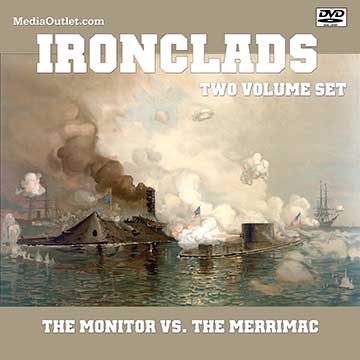
January 30, 1862: The American Civil War
(The Civil War, The War Between The States): Naval History: The
History Of The United States Navy: The Old United States Navy (The
Old Navy): Naval Launches: Ironclads: The USS Monitor: -- The
first American ironclad warship, the USS Monitor, is launched. An
iron-hulled steamship built during the American Civil War, she was
the first ironclad warship commissioned by the Union Navy. Monitor
is most famous for her central role in the Battle of Hampton Roads
on 9 March 1862, where, under the command of Lieutenant John
Worden, she fought the casemate ironclad CSS Virginia (built on
the hull of the former steam frigate USS Merrimack) to a
standstill. The unique design of the ship, distinguished by its
revolving turret which was designed by American inventor Theodore
Timby, was quickly duplicated and established the monitor type of
warship. The remainder of the ship was designed by the
Swedish-born engineer and inventor John Ericsson and hurriedly
built in Brooklyn in only 101 days. Monitor presented a new
concept in ship design and employed a variety of new inventions
and innovations in ship building that caught the attention of the
world. The impetus to build Monitor was prompted by the news that
the Confederates were building an ironclad warship, named
Virginia, that could effectively engage the Union ships blockading
Hampton Roads and the James River leading to Richmond and
ultimately advance on Washington, D.C. and other cities, virtually
unchallenged. Before Monitor could reach Hampton Roads, the
Confederate ironclad had destroyed the sail frigates USS
Cumberland and USS Congress and had run the steam frigate USS
Minnesota aground. That night Monitor arrived and the following
morning, just as Virginia set to finish off Minnesota, the new
Union ironclad confronted the Confederate ship, preventing her
from wreaking further destruction on the wooden Union ships. A
four-hour battle ensued, both ships pounding the other with
close-range cannon fire, although neither ship could destroy or
seriously damage the other. This was the first-ever battle fought
between two armored warships and marked a turning point in naval
warfare. After the Confederates were forced to destroy Virginia as
they withdrew in early May, Monitor sailed up the James River to
support the Union Army during the Peninsula Campaign. The ship
participated in the Battle of Drewry's Bluff later that month and
remained in the area giving support to General McClellan's forces
on land until she was ordered to join the blockaders off North
Carolina in December. On her way there she foundered while under
tow, during a storm off Cape Hatteras on the last day of the year.
Monitor's wreck was discovered in 1973 and has been partially
salvaged. Her guns, gun turret, engine and other relics are on
display at the Mariners' Museum in Newport News, Virginia. On Sale
@ 15% Off Discount Till Midnight PT!
https://store.earthstation1.com/ironclads-monitor-vs-merrimac-dvd-us-civil-war-documentary.html
Today's
EarthStation1.com 15% Off Commemorative Memorial Title: Franklin
D. Roosevelt Documentaries DVD, Video Download, USB Drive
Today, January 30, 2026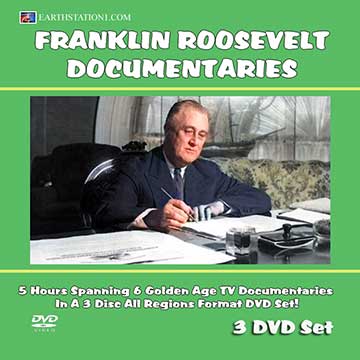
January 30, 1882: #BOTD: #HBD! Franklin
D. Roosevelt, American lawyer and politician, New York State
Senator, Assistant Secretary Of The Navy, Governor of New York,
32nd President of the United States (d. April 12, 1945) is #born
Franklin Delano Roosevelt in the Hudson Valley town of Hyde Park,
New York, to businessman James Roosevelt I and his second wife,
Sara Ann Delano. Often referred to by his initials FDR, Franklin
D. Roosevelt served as the 32nd president of the United States
from 1933 until his death in 1945. A member of the Democratic
Party, he won a record four presidential elections and became a
central figure in world events during the first half of the 20th
century. Roosevelt directed the federal government during most of
the Great Depression, implementing his New Deal domestic agenda in
response to the worst economic crisis in U.S. history. As a
dominant leader of his party, he built the New Deal Coalition,
which realigned American politics into the Fifth Party System and
defined American liberalism throughout the middle third of the
20th century. His third and fourth terms were dominated by World
War II, which ended shortly after he died in office. He is rated
by scholars as one of the three greatest U.S. presidents, along
with George Washington and Abraham Lincoln. Roosevelt was born in
Hyde Park, New York, to a Dutch American family made well known by
the reputation of Theodore Roosevelt, the 26th president of the
United States, and William Henry Aspinwall. FDR graduated from
Groton School and Harvard College and attended Columbia Law School
but left after passing the bar exam to practice law in New York
City. In 1905, he married his fifth cousin once removed, Eleanor
Roosevelt. They had six children, of whom five survived into
adulthood. He won election to the New York State Senate in 1910,
and then served as Assistant Secretary of the Navy under President
Woodrow Wilson during World War I. Roosevelt was James M. Cox's
running mate on the Democratic Party's 1920 national ticket, but
Cox was defeated by Republican Warren G. Harding. In 1921,
Roosevelt contracted a paralytic illness, believed at the time to
be polio, and his legs became permanently paralyzed. While
attempting to recover from his condition, Roosevelt founded the
treatment center in Warm Springs, Georgia, for people with
poliomyelitis. In spite of being unable to walk unaided, Roosevelt
returned to public office by winning election as Governor of New
York in 1928. He was in office from 1929 to 1933 and served as a
reform Governor, promoting programs to combat the economic crisis
besetting the United States at the time. In the 1932 presidential
election, Roosevelt defeated Republican President Herbert Hoover
in a landslide. Roosevelt took office in the midst of the Great
Depression, the worst economic crisis in United States History.
During the first 100 days of the 73rd United States Congress,
Roosevelt spearheaded unprecedented federal legislation and issued
a profusion of executive orders that instituted the New Deal-a
variety of programs designed to produce relief, recovery, and
reform. He created numerous programs to provide relief to the
unemployed and farmers while seeking economic recovery with the
National Recovery Administration and other programs. He also
instituted major regulatory reforms related to finance,
communications, and labor, and presided over the end of
Prohibition. He harnessed radio to speak directly to the American
people, giving 30 "fireside chat" radio addresses during
his presidency and becoming the first American president to be
televised. The economy having improved rapidly from 1933 to 1936,
Roosevelt won a landslide reelection in 1936. However, the economy
then relapsed into a deep recession in 1937 and 1938. After the
1936 election, Roosevelt sought passage of the Judiciary
Reorganization Bill of 1937 (the "court packing plan"),
which would have expanded the size of the Supreme Court Of The
United States. The bipartisan Conservative Coalition that formed
in 1937 prevented passage of the bill and blocked the
implementation of further New Deal programs and reforms. Major
surviving programs and legislation implemented under Roosevelt
include the Securities and Exchange Commission, the National Labor
Relations Act, the Federal Deposit Insurance Corporation, Social
Security, and the Fair Labor Standards Act of 1938, which, among
other things, prohibited child labor and created the right to a
minimum wage. The United States reelected FDR in 1940 for his
third term, making him the only U.S. President to serve for more
than two terms. With World War II looming after 1938, Roosevelt
gave strong diplomatic and financial support to China, the United
Kingdom and eventually the Soviet Union while the U.S. remained
officially neutral. Following the Japanese attack on Pearl Harbor
on December 7, 1941, an event he famously called "a date
which will live in infamy", Roosevelt obtained a
congressional declaration of war on Japan, and, a few days later,
on Germany and Italy. Assisted by his top aide Harry Hopkins and
with very strong national support, he worked closely with British
Prime Minister Winston Churchill, Soviet leader Joseph Stalin and
Chinese Generalissimo Chiang Kai-shek in leading the Allied Powers
against the Axis Powers. Roosevelt supervised the mobilization of
the U.S. economy to support the war effort, and implemented a
Europe first strategy, making the defeat of Germany a priority
over that of Japan. He also initiated the development of the
world's first atomic bomb, and worked with the other Allied
leaders to lay the groundwork for the United Nations and other
post-war institutions. Roosevelt won reelection in 1944, but with
his physical health declining during the war years, he died
suddenly at 3:35 p.m. in Warm Springs, Georgia while sitting for a
portrait, aged 63. Roosevelt said: "I have a terrific
headache", then slumped forward in his chair, unconscious,
and was carried into his bedroom. The president's attending
cardiologist, Howard Bruenn, diagnosed the medical emergency as a
massive intracerebral hemorrhage. The following morning, Franklin
Delano Roosevelt's body was placed in a flag-draped coffin and
loaded onto the presidential train for the trip back to
Washington. Along the route, thousands flocked to the tracks to
pay their respects. After a White House funeral on April 14,
Roosevelt was transported by train from Washington, D.C., to his
place of birth at Hyde Park. On April 15 he was buried, per his
wish, in the rose garden of his Springwood estate. The Axis Powers
surrendered to the Allies in the months following Roosevelt's
death, during the presidency of his successor, Harry S. Truman. On
Sale @ 15% Off Discount Till Midnight PT!
https://store.earthstation1.com/franklin-roosevelt-documentaries-dual-layer-dvd.html
Today's
EarthStation1.com 15% Off Commemorative Memorial Title: The Guns
Of August (1964) WWI Film DVD, Video Download, USB Drive
Today, January 30, 2026
January 30, 1912: #BOTD: #HBD! Barbara
Tuchman (Barbara W. Tuchman), American historian and author,
winner of the Pulitzer Prize twice, for The Guns of August (1962),
a best-selling history of the prelude to and the first month of
World War I, and Stilwell and the American Experience in China
(1971), a biography of General Joseph Stilwell (d. February 6,
1989) is #born Barbara Wertheim into the distinguished family of
the banker Maurice Wertheim and his first wife Alma Morgenthau.
Her father was an individual of wealth and prestige, the owner of
The Nation magazine, president of the American Jewish Committee,
prominent art collector, and a founder of the Theatre Guild. Her
mother was the daughter of Henry Morgenthau, Woodrow Wilson's
ambassador to the Ottoman Empire during World War I; Morgenthau
was one of the most prominent Americans who spoke about the Greek
genocide and the Armenian genocide of which he stated, "I am
firmly convinced that this is the greatest crime of the ages".
Barbara Wertheim Tuchman focused on writing popular history. While
she did not explicitly mention it in her book The Guns of August,
Tuchman was present for one of the pivotal events of the book: the
pursuit of the German battle cruiser Goeben and light cruiser
Breslau. In her account of the pursuit she wrote, "That
morning there arrived in Constantinople the small Italian
passenger steamer which had witnessed the Gloucester's action
against Goeben and Breslau. Among its passengers were the
daughter, son-in-law and three grandchildren of the American
ambassador Mr. Henry Morgenthau." As she was a grandchild of
Henry Morgenthau, she is referring to herself, which is confirmed
in her later book Practicing History, in which she tells the story
of her father, Maurice Wertheim, traveling from Constantinople to
Jerusalem on August 29, 1914, to deliver funds to the Jewish
community there. Thus, at two, Tuchman was present during the
pursuit of Goeben and Breslau, which she documented 48 years
later. Tuchman died in 1989 in Greenwich, Connecticut, following a
stroke, at age 77. She is buried at Temple Israel Cemetery in
Hastings-On-Hudson, New York. On Sale @ 15% Off Discount Till
Midnight PT!
https://store.earthstation1.com/the-guns-of-august-dvd-1964-world-war-i-movie-documen1964.html
Today's
EarthStation1.com 15% Off Commemorative Memorial Title: An Ocean
Apart: US-UK Relations TV Series + Profumo Affair MP4 DVD Set
Today, January 30, 2026
January 30, 1915: #BOTD: #HBD: John
Profumo, English soldier and politician whose career ended in 1963
after a sexual relationship with the 19-year-old model Christine
Keeler in 1961, Secretary Of State for War (d. March 9, 2006) is
#born John Dennis Profumo in Kensington, London, England. On June
5, 1963, British Secretary Of State for War John Profumo resigned
in a sex scandal known as the "Profumo Affair", a
British political scandal that originated with a brief sexual
relationship in 1961 between John Profumo, the Secretary Of State
for War in Harold Macmillan's Conservative government, and
Christine Keeler, a 19-year-old would-be model. In March 1963,
Profumo's denial of any impropriety, in a personal statement to
the House Of Commons, was refuted a few weeks later with his
admission of the truth. He resigned from the government and from
Parliament. The repercussions of the affair severely damaged
Macmillan's self-confidence, and he resigned as Prime Minister on
health grounds in October 1963. His Conservative Party was marked
by the scandal, which may have contributed to its defeat by the
Labour Party in the 1964 general election. When the Profumo-Keeler
affair was first revealed, public interest was heightened by
reports that Keeler may have been simultaneously involved with
Captain Yevgeny Ivanov, a Soviet naval attache, thereby creating a
possible security risk. Keeler knew both Profumo and Ivanov
through her friendship with Stephen Ward, an osteopath and
socialite who had taken her under his wing. The exposure of the
affair generated rumours of other scandals, and drew official
attention to the activities of Ward, who was charged with a series
of immorality offences. Perceiving himself as a scapegoat for the
misdeeds of others, Ward took a fatal overdose during the final
stages of his trial, which found him guilty of living off the
immoral earnings of Keeler and her friend Mandy Rice-Davies. An
inquiry into the affair by a senior judge, Lord Denning, indicated
that there had been no breaches of security arising from the
Ivanov connection, although Denning's report was later condemned
as superficial and unsatisfactory. Profumo subsequently sought
private atonement as a volunteer worker at Toynbee Hall, an East
London charitable trust. He died in 2006. Keeler found it
difficult to escape the negative image attached to her by press,
law and parliament throughout the Profumo affair. In various,
sometimes contradictory accounts, she has challenged Denning's
conclusions relating to security issues. Ward's conviction has
been described by analysts as an act of Establishment revenge,
rather than serving justice. In January 2014 his case was under
review by the Criminal Cases Review Commission, with the
possibility of a later reference to the Court of Appeal.
Dramatisations of the Profumo affair have been shown on stage and
screen. The influential British satirical television programme,
That Was The Week That Was, also known as TW3, a satirical
television comedy programme on BBC Television in 1962 and 1963
that was devised, produced and directed by Ned Sherrin and
presented by David Frost that is considered a significant element
of the satire boom in the UK in the early 1960s and broke ground
in comedy through lampooning the establishment and political
figures, coincided with coverage of the politically charged
Profumo affair and John Profumo, the politician at the centre of
the affair, lending much to the show's popularity and its effects
on British culture. John Profumo died of a stroke at London,
England's Chelsea and Westminster Hospital at the age of 91. After
his death, many commentators said that he should be remembered as
much for his contribution to society after his fall from political
grace as for the scandal of 1963 which caused that fall. He was
cremated at Mortlake Crematorium; his ashes were buried next to
those of his wife at the family vault in front of St Peter's
Church in Hersham. On Sale @ 15% Off Discount Till Midnight PT!
https://store.earthstation1.com/an-ocean-apart-us-uk-relations-tv-series-profumo-affair-mp4-dvd-set.html
Today's
EarthStation1.com 15% Off Commemorative Memorial Title: Rowan &
Martin's Laugh-In MegaSet 2 Albums 2 Blooper Sets MP3 MP4 DVD
Today, January 30, 2026
January 30, 1922: #BOTD: #HBD! Dick
Martin, American comedian, actor, and director, best known for his
role as the cohost of the sketch comedy program Rowan and Martin's
Laugh-In from 1968-73 (d. May 24, 2008) is #born Thomas Richard
Martin in Battle Creek, Michigan to William, a salesman and Ethel
Martin, a homemaker. In the early 1930s, the family moved to
Detroit, where his teenage years included a bout with
tuberculosis, which kept him out of the military. He graduated
from Michigan State University. Early in his career, Martin was a
staff writer for Duffy's Tavern, a radio situation comedy. He and
Dan Rowan formed the comedy team Rowan and Martin in 1952 and
played in nightclubs throughout the United States and overseas.
Martin played a drunk heckling a Shakespearean performer, a
mainstay of their act for years. They could frequently be seen as
host-performers on NBC's Colgate Comedy Hour, alternating with
Dean Martin and Jerry Lewis and other more established names. In
1958, they starred in Hal Kanter's comedy Western Once Upon a
Horse which failed to catch on with moviegoers. In 1960, their
contract with NBC was cancelled four years early by mutual
consent. In 1962, Martin worked solo, playing next-door neighbor
to Lucille Ball during the first season of her comeback comedy The
Lucy Show. He and Rowan returned to the nightclub circuit until
1966, when they were asked to host the summer replacement series
for the Dean Martin Show. He co-starred in the 1966 Doris Day
movie The Glass Bottom Boat. The exposure led to an opportunity
for Rowan and Martin to team up with producers Ed Friendly and
George Schlatter and create Rowan and Martin's Laugh-In
(1968-1973) on NBC. The comedy show was an immediate hit, becoming
the number one American television program within two months of
its debut. It was the top-rated show in its second and third
seasons. Laugh-In had a uniquely fast-paced
stream-of-consciousness style of blackout gags, double entendre,
topical satire, and catchphrases, much of it delivered by a cast
of then-unknowns such as Goldie Hawn, Lily Tomlin, and Arte
Johnson. At the center of the maelstrom stood the veterans Rowan
and Martin, who bemusedly made no effort to slow down the program.
Martin later said, "We designed it so that we are two
relatively normal guys wandering through a sea of madness,"
and described his comic persona as "a kind of inept lech"
who could be laughed at as well as laughed with. In real life,
Martin spent the 1960s enjoying his high-flying lifestyle of women
and parties. After Rowan retired from show business, Martin was a
frequent panelist on game shows such as Match Game, Password Plus,
and Tattletales, and he also hosted a parody game show called The
Cheap Show in 1978, and the game show Mindreaders in 1979. Martin
also established himself as an efficient comedy director. Starting
on The Bob Newhart Show, he directed for over a dozen series.
Martin later became the chief director of the 1980s sitcom
Newhart. In a 1998 episode of The Nanny, Martin guest-starred as a
homeless man Fran Fine meets in a park who turns out to be Preston
Collier, one of the wealthiest men in New York City. In 1992, he
played a small role in the Canadian film North of Pittsburgh,
which was directed by his son Richard. In 1996, Martin guest
starred as sociology professor Dr. Ben Littmeyer on 3rd Rock from
the Sun. Martin's son Richard was born in 1956. He married singer
Peggy Connelly in 1957, and after divorcing her he married Playboy
Playmate and Beyond the Valley of the Dolls star Dolly Read in
1971. Martin and Read divorced in June 1974, but remarried in 1978
and remained married until his death. Martin died of breathing
complications at the age of 86 in Santa Monica, California. He had
lost the use of a lung due to tuberculosis as a teenager and
suffered respiratory problems late in life. His remains were
cremated, and the ashes were scattered in The Pacific Ocean. On
Sale @ 15% Off Discount Till Midnight PT!
https://store.earthstation1.com/rowan-and-martin-discount-set-2-albums-2-blooper-reel-sets-mp3-mp4-dvd.html
Today's
EarthStation1.com 15% Off Commemorative Memorial Title: Unknown
Chaplin (1983) Charlie Chaplin TV Series DVD, Download, USB
Today, January 30, 2026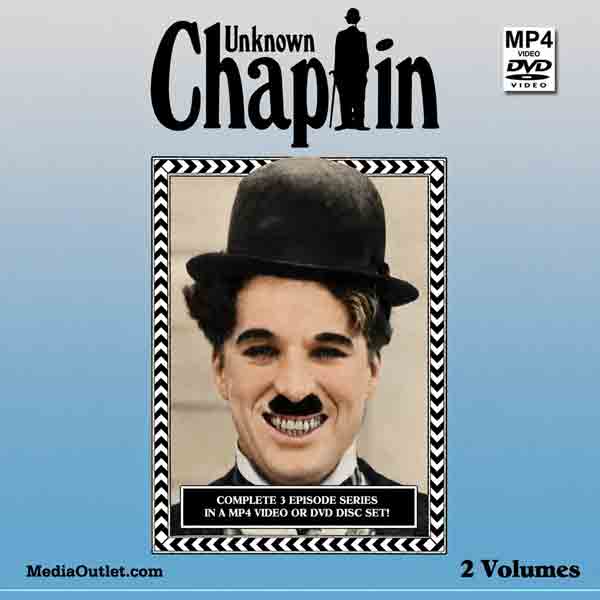
January 30, 1931: Aesthetics: Performing
Arts: Premieres: Film Premieres: American Film Premieres: -- City
Lights, an American silent romantic comedy-drama film written,
produced, directed by and starring Charlie Chaplin, of which
critic James Agee said the film's final scene was "the
greatest single piece of acting ever committed to celluloid",
and in the words of Chaplin biographer Jeffrey Vance "City
Lights is not only Charles Chaplin's masterpiece; it is an act of
defiance" as it premiered four years into the era of sound
films which began with the premiere of The Jazz Singer (1927)
premieres at The Los Angeles Theatre, a 2,000-seat historic movie
palace at 615 S. Broadway in the historic Broadway Theater
District in Downtown Los Angeles, where Albert Einstein and his
wife were the guests of honor (Albert Einstein said Chaplin was
the only person in Hollywood he wanted to meet), and the film
received a standing ovation. Chaplin closely supervised the
release, spending the day doing interviews, and previously
spending 60K USD on the advertising, as he was frustrated with
what UA's publicists had come up with. Chaplin demanded half of
the total gross, and considering audiences would be more attracted
by the film itself than its technology, he demanded higher ticket
prices compared to talkies. City Lights follows the misadventures
of Chaplin's Tramp as he falls in love with a blind girl (Virginia
Cherrill) and develops a turbulent friendship with an alcoholic
millionaire (Harry Myers). Although sound films were on the rise
when Chaplin started developing the script in 1928, he decided to
continue working with silent productions. Filming started in
December 1928 and ended in September 1930. City Lights marked the
first time Chaplin composed the film score to one of his
productions and it was written in six weeks with Arthur Johnston.
The main theme, used as a leitmotif for the blind flower girl, is
the song "La Violetera" ("Who'll Buy my Violets")
from Spanish composer Jose Padilla. Chaplin lost a lawsuit to
Padilla for not crediting him. City Lights was immediately
successful upon release on January 30, 1931, with positive reviews
and worldwide rentals of more than 4M USD. Today, many critics
consider it not only the highest accomplishment of Chaplin's
career, but one of the greatest films of all time. In 1991, the
Library of Congress selected City Lights for pres On Sale @ 15%
Off Discount Till Midnight PT!
https://store.earthstation1.com/unknown-chaplin-tv-miniseries-1983-dvd-2-19832.html
Today's
EarthStation1.com 15% Off Commemorative Memorial Title: The Adolf
Hitler Documentaries Collection DVD, Download, USB Drive
Today, January 30, 2026
January 30, 1933: The Interwar Period
(The Aftermath Of World War I, The Interbellum, Between The Wars):
The Road To War: Adolf Hitler's Rise To Power: -- Adolf Hitler is
sworn in as Chancellor of Germany during a brief ceremony in
Hindenburg's office, having been appointed by President Paul Von
Hindenburg through the political machinations of outgoing
Chancellor Franz Von Papen. The publication of the
Industrielleneingabe, a letter signed by 22 important
representatives of industry, finance and agriculture, asked
Hindenburg to appoint Hitler as chancellor. Hindenburg reluctantly
agreed to this only after the parliamentary elections of July and
November 1932 had not resulted in the formation of a majority
government. At this same ceremony of Hitler's swearing in, his new
cabinet was sworn in as well, gaining the NSDAP (Nazi Party) a
total of three posts: Adolf Hitler as Chancellor, Wilhelm Frick as
Minister of the Interior, and Hermann Goering as Minister Without
Portfolio (and Minister of the Interior for Prussia). The SA and
SS led torchlit parades throughout Berlin. It is this event that
would become termed Hitler's Machtergreifung ("seizure of
power"). The term was originally used by some Nazis to
suggest a revolutionary process, though Hitler, and others, used
the word Machtubernahme ("take-over of power"),
reflecting that the transfer of power took place within the
existing constitutional framework and suggesting that the process
was legal. When Papen left office, he secretly told Hitler that he
still held considerable sway with President Hindenburg and that he
would make Hitler chancellor as long as he, Papen, could be the
vice chancellor. Papen was to serve as Vice-Chancellor in a
majority conservative Cabinet, falsely believing that he could
"tame" Hitler. Initially, Papen did speak out against
some Nazi excesses. However, after narrowly escaping death in the
Night of the Long Knives in 1934, he no longer dared criticise the
regime and was sent off to Vienna as German ambassador. Both
within Germany and abroad initially there were few fears that
Hitler could use his position to establish his later dictatorial
single-party regime. Rather, the conservatives that helped to make
him chancellor were convinced that they could control Hitler and
"tame" the Nazi Party while setting the relevant
impulses in the government themselves; foreign ambassadors played
down worries by emphasizing that Hitler was "mediocre"
if not a bad copy of Mussolini; even SPD politician Kurt
Schumacher trivialized Hitler as a "Dekorationsstuck"
("piece of scenery/decoration") of the new government.
German newspapers wrote that, without doubt, the Hitler-led
government would try to fight its political enemies (the left-wing
parties), but that it would be impossible to establish a
dictatorship in Germany because there was "a barrier, over
which violence cannot proceed" and because of the German
nation being proud of "the freedom of speech and thought".
Nevertheless, Hitler went on to become the sole leader of Nazi
Germany. He then waged a war of expansion in Europe, precipitating
the deaths of an estimated 50 million persons through military
conflict and through the Holocaust in which the Nazis attempted to
exterminate the entire Jewish population of Europe. On Sale @ 15%
Off Discount Till Midnight PT!
https://store.earthstation1.com/adolf-hitler-documentaries-world-war-ii-3rd-reich-dual-layer-dv3.html
Today's
EarthStation1.com 15% Off Commemorative Memorial Title: Camera
Magic Images Of Nature Oxford Scientific Films DVD, MP4, USB
Today, January 30, 2026
January 30, 1951: #BOTD: #HBD! Phil
Collins, English drummer, singer, songwriter,
multi-instrumentalist, record producer, and actor, is #born Philip
David Charles Collins in Putney Hospital, southwest London. He was
the drummer then also later the singer of the rock band Genesis,
and is also a solo artist. Between 1982 and 1989, Collins scored
three UK and seven US number-one singles in his solo career. When
his work with Genesis, his work with other artists, as well as his
solo career is totalled, he had more US Top 40 singles than any
other artist during the 1980s. His most successful singles from
the period include "In the Air Tonight", "Against
All Odds (Take a Look at Me Now)", "One More Night",
"Sussudio", "Two Hearts" and "Another Day
in Paradise". Born and raised in west London, Collins played
drums from the age of five and completed drama school training,
which secured him various roles as a child actor. He then pursued
a music career, joining Genesis in 1970 as their drummer and
becoming lead singer in 1975 following the departure of Peter
Gabriel. Collins began a solo career in the 1980s, initially
inspired by his marital breakdown and love of soul music,
releasing a series of successful albums, including Face Value
(1981), No Jacket Required (1985), and ...But Seriously (1989).
Collins became "one of the most successful pop and adult
contemporary singers of the '80s and beyond". He also became
known for a distinctive gated reverb drum sound on many of his
recordings. In 1996, Collins left Genesis to focus on solo work;
this included writing songs for Disney's Tarzan (1999) for which
he received an Oscar for Best Original Song for "You'll Be in
My Heart". He rejoined Genesis for their Turn It On Again
Tour in 2007. Following a five-year retirement to focus on his
family life, Collins released an autobiography in 2016 and
completed his 97-date Not Dead Yet Tour in 2019. Collins's
discography includes eight studio albums that have sold 33.5
million certified units in the US and an estimated 150 million
worldwide, making him one of the world's best-selling artists. He
is one of only three recording artists, along with Paul McCartney
and Michael Jackson, who have sold over 100 million records
worldwide both as solo artists and separately as principal members
of a band. He has received eight Grammy Awards, six Brit Awards
(winning Best British Male Artist three times), two Golden Globe
Awards, one Academy Award, and a Disney Legend Award. He was
awarded six Ivor Novello Awards from the British Academy of
Songwriters, Composers and Authors, including the International
Achievement Award. He received a star on the Hollywood Walk of
Fame in 1999, and was inducted into the Songwriters Hall of Fame
in 2003 and The Rock And Roll Hall Of Fame as a member of Genesis
in 2010. He has also been recognised by music publications with
induction into the Modern Drummer Hall of Fame in 2012, and the
Classic Drummer Hall of Fame in 2013. On Sale @ 15% Off Discount
Till Midnight PT!
https://store.earthstation1.com/camera-magic-images-of-nature--oxford-scientific-films-dvd.html
Today's
EarthStation1.com 15% Off Commemorative Memorial Title: King: A
Filmed Record: Montgomery To Memphis DVD, Download, USB Drive
Today, January 30, 2026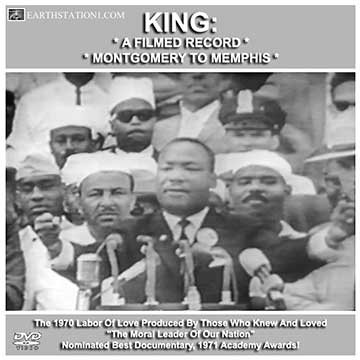
January 30, 1956: Civil Rights Movements:
The American Civil Rights Movement (1954-1968): Anti-Black Racism
In The United States: Segregation: Racial Segregation: Civil
Rights Protests: Civil Rights Protests In The United States:
Transport And Bus Segregation In The United States: Transport And
Bus Boycotts In The United States: The Montgomery Bus Boycott: The
1956 Bombing Of Martin Luther King Jr.'s Home: -- Martin Luther
King Jr.'s home is bombed in retaliation for the Montgomery Bus
Boycott. King's wife Coretta, and Dexter congregation member
Roscoe Williams's wife Mary Lucy, heard the "sound of a brick
striking the concrete floor of the front porch." Coretta
suggested that the two women get out of the front room and went
into the guest room, as the house was disturbed by an explosion
which caused the house to rock and fill the front room with smoke
and shattered glass. The two went to the rear of the home, where
Yolanda was sleeping and Coretta called the First Baptist Church
and reported the bombing to the woman who answered the phone.
Martin returned to their home, and upon finding Coretta and his
daughter unharmed, went outside. He was confronted by an angry
crowd of his supporters, who had brought guns. He was able to turn
them away with an impromptu speech. A white man was reported by a
lone witness to have walked halfway up to King's door and thrown
something against the door before running back to his car and
speeding off. Ernest Walters, the lone witness, did not manage to
get the license plate number because of how quickly the events
transpired. Both of the couple's fathers contacted them over the
bombing. The two arrived nearly at the same time, along with her
husband's mother and brother. Coretta's father Obie said he would
take her and her daughter back to Marion if his son-in-law did not
take them to Atlanta. Coretta refused the proclamation and
insisted on staying with her husband. Despite Martin Luther King
Sr. also advocating that she leave with her father, King persisted
in leaving with him. Author Octavia B. Vivian wrote "That
night Coretta lost her fear of dying. She committed herself more
deeply to the freedom struggle, as Martin had done four days
previously when jailed for the first time in his life."
Coretta would later call it the first time she realized "how
much I meant to Martin in terms of supporting him in what he was
doing". On Sale @ 15% Off Discount Till Midnight PT!
https://store.earthstation1.com/king-a-filmed-record--montgomery-to-memphis-dvd.html
Today's
EarthStation1.com 15% Off Commemorative Memorial Title: Civil
Rights OTR: Destination Freedom, New World A-Coming CD MP3 USB
Today, January 30, 2026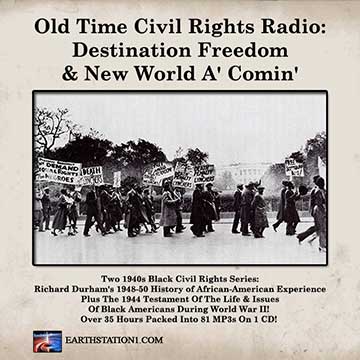
January 30, 1965: Sports: The History Of
Sports: The History Of Sports In The United States: The History Of
Baseball: The History Of Baseball In The United States: The
History Of Major League Baseball: -- Satchel Paige, African
American professional baseball pitcher who played in Negro league
baseball and Major League Baseball (MLB), is named the all-time
outstanding player by The National Baseball Congress. Satchel
Paige, African American baseball pitcher who played in Negro
league baseball and Major League Baseball (MLB) in a career
spanning five decades culminating in his induction into the
National Baseball Hall of Fame, actor, author, sheriff and
political candidate (July 7, 1906 - June 8, 1982) was born Leroy
Robert Paige in Mobile, Alabama. A right-handed pitcher, Paige
first played for the semi-professional Mobile Tigers from 1924 to
1926. He began his professional baseball career in 1926 with the
Chattanooga Black Lookouts of the Negro Southern League and became
one of the most famous and successful players from the Negro
leagues. On town tours across the United States, Paige would
sometimes have his infielders sit down behind him and then
routinely strike out the side. At age 42 in 1948, Paige made his
debut for the Cleveland Indians; to this day, this makes him the
oldest debutant in the National League or American League history.
Additionally, Paige was 59 years old when he played his last major
league game, which is also a record that stands to this day. Paige
was the first black pitcher to play in the American League and was
the seventh black player to play in Major League Baseball. Also in
1948, Paige became the first player who had played in the Negro
leagues to pitch in the World Series; the Indians won the Series
that year. He played with the St. Louis Browns from 1951 to 1953,
representing the team in the All-Star Game in 1952 and 1953. He
played his last professional game on June 21, 1966, for the
Peninsula Grays of the Carolina League, two weeks shy of 60. In
1971, Paige became the first electee of the Negro League Committee
to be inducted into the Baseball Hall of Fame. After the 1957
season, Paige went to the Mexican state of Durango to appear in a
United Artists movie, The Wonderful Country, starring Robert
Mitchum and Julie London. Paige played Sgt. Tobe Sutton, a
hard-bitten cavalry sergeant of the Buffalo Soldiers. Late in
1960, Paige began collaborating with writer David Lipman on his
autobiography, which was published by Doubleday in April 1962, and
ran to three printings. In 1968, Paige assumed the position of
deputy sheriff in Jackson County, Missouri, with the understanding
that he need not bother to actually come to work in the sheriff's
office. The purpose of the charade was to set up Paige with
political credentials. Soon after, he ran for a Missouri state
assembly seat with the support of the local Democratic club
against incumbent Representative Leon Jordan, a race which Paige
lost. On December 19, 1987, Mia Farrow gave birth to Satchel
Farrow (later known as Ronan Farrow), so named by Woody Allen in
his honor. Satchel Paige died of a heart attack after a power
failure at his home in Kansas City, aged 75. He is buried on Paige
Island in the Forest Hill Memorial Park Cemetery in Kansas City.
On Sale @ 15% Off Discount Till Midnight PT!
https://store.earthstation1.com/destination-freedom-new-world-a39comin39-mp3-cd-civil-rights-39393.html
Today's
EarthStation1.com 15% Off Commemorative Memorial Title: TET! The
Tet Offensive Of The Vietnam War MP4 Video Download DVD
Today, January 30, 2026
January 30, 1968: The Aftermath Of World
War II: The Cold War: The Cold War In Asia: The Indochina Wars:
The Vietnam War (The Second Indochina War, The Vietnam Conflict,
The Resistance War Against America): The United States In The
Vietnam War: The Tet Offensive: Phase 1 Of The Tet Offensive: --
During the Tet (Vietnamese New Year) holidays, the Year Of The
Monkey begins in earnest with the beginning of Phase I Of The Tet
Offensive, the surprise attack of North Vietnamese and Viet Cong
troops against 36 provincial capitals and 5 major cities in South
Vietnam, including an attack on the U.S. Embassy in Saigon and the
presidential palace. Although U.S. forces eventually fended off
the massive surprise attack and achieved a military victory, Tet
became a propaganda victory for the Vietnamese due in part to
graphic news reports on television which helped turn U.S. public
opinion against continuation of the war. The Tet Offensive,
officially known by the North Vietnamese and Viet Cong as The
General Offensive and Uprising of Tet Mau Than 1968, was one of
the largest military campaigns of the Vietnam War, launched on
January 30, 1968 by forces of the Viet Cong and North Vietnamese
People's Army of Vietnam (PAVN) against the forces of the South
Vietnamese Army of the Republic of Vietnam (ARVN), the United
States Armed Forces and their allies. It was a campaign of
surprise attacks against military and civilian command and control
centers throughout South Vietnam. The offensive was launched
prematurely in the late night hours of 30 January in the I and II
Corps Tactical Zones of South Vietnam. This early attack allowed
allied forces some time to prepare defensive measures. When the
main operation began the next morning, the offensive was
countrywide and well coordinated; eventually more than 80,000
PAVN/VC troops struck more than 100 towns and cities, including 36
of 44 provincial capitals, five of the six autonomous cities, 72
of 245 district towns, and the southern capital. The offensive was
the largest military operation conducted by either side up to that
point in the war. Hanoi had launched the offensive in the belief
that the offensive would trigger a popular uprising leading to the
collapse of the South Vietnamese government. Although the initial
attacks stunned the allies, causing them to lose control of
several cities temporarily, they quickly regrouped, beat back the
attacks, and inflicted heavy casualties on PAVN/VC forces. The
popular uprising anticipated by Hanoi never happened. During the
Battle of Hue, intense fighting lasted for a month, resulting in
the destruction of the city. During their occupation, the PAVN/VC
executed thousands of people in the Massacre at Hue. Around the
U.S. combat base at Khe Sanh, fighting continued for two more
months. The offensive was a military defeat for North Vietnam
though General Westmoreland reported that defeating the PAVN/VC
would require 200,000 more American soldiers and activation of the
reserves, prompting even loyal supporters of the war to see that
the current war strategy required re-evaluation. The offensive had
a strong effect on the U.S. government and shocked the U.S.
public, which had been led to believe by its political and
military leaders that the North Vietnamese were being defeated and
incapable of launching such an ambitious military operation;
American public support for the war soon declined and the U.S.
sought negotiations to end the war. On Sale @ 15% Off Discount
Till Midnight PT!
https://store.earthstation1.com/tet-the-tet-offensive-of-the-vietnam-war-mp4-video-download-dvd.html
Today's
EarthStation1.com 15% Off Commemorative Memorial Title: Let It Be
(1970) Beatles Final Film DVD, Video Download, Flash Drive
Today, January 30, 2026
January 30, 1969: Aesthetics: The
Performing Arts: Music: Music History: The History Of Rock And
Roll (Rock & Roll, Rock-N-Roll, Rock 'N' Roll, Rock 'N Roll,
Rock N' Roll): British Rock And Roll (British Rock & Roll,
British Rock-N-Roll, British Rock 'N' Roll, British Rock 'N Roll,
British Rock N' Roll): The Swinging Sixties: Music Of The United
Kingdom: Rock And Roll (Rock & Roll, Rock-N-Roll, Rock 'N'
Roll, Rock 'N Roll, Rock N' Roll): Concerts: British Rock (Beat
Music, British Beat, Merseybeat): The Swinging Sixties: Music Of
The United Kingdom: Rock And Roll (Rock & Roll, Rock-N-Roll,
Rock 'N' Roll, Rock 'N Roll, Rock N' Roll): The British Invasion:
The Beatles: Finales: The Beatles' Rooftop Concert: -- The Beatles
give their last public performance, with keyboardist Billy
Preston, and surprised a central London office and fashion
district with an impromptu concert from the roof of the
headquarters of the band's multimedia corporation Apple Corps at 3
Savile Row. The band played a 42-minute set before the
Metropolitan Police arrived and ordered them to reduce the volume.
It was the final public performance of their career. They
performed nine takes of five new songs as crowds of onlookers,
many on lunch breaks, congregated in the streets and on the
rooftops of nearby buildings to listen. The concert ended with
"Get Back", and John Lennon joking, "I'd like to
say thank you on behalf of the group and ourselves, and I hope
we've passed the audition." The entire performance was filmed
and recorded, and footage from the performance was later used in
the 1970 documentary film Let It Be. On Sale @ 15% Off Discount
Till Midnight PT!
https://store.earthstation1.com/let-it-be-1970-the-beatles-dvd-download-usb-flashd1970.html
Today's
EarthStation1.com 15% Off Commemorative Memorial Title: Desert
Storm: The Victory + Bonus Persian Gulf War I MP4 Download DVD
Today, January 30, 2026
January 30, 1991 : The Aftermath Of World
War II: The Cold War: The Cold War (1985-1991) (The End Of The
Cold War): The Gulf War (The Persian Gulf War, Gulf War I):
Operation Desert Storm: The Battle Of Khafji: -- Coalition forces
begin its first land operations in Kuwait and Southern Iraq when
two Saudi Arabian National Guard battalions and two Qatari tank
companies attempt to retake control of the north-eastern Saudia
Arabian city of Khafji from Iraqi invaders, aided by Coalition
aircraft and U.S. artillery. By February 1, the city had been
recaptured at the cost of 43 Coalition servicemen dead and 52
wounded, with Iraqi Army fatalities between 60 and 300, while an
estimated 400 were captured as prisoners of war. Although the
invasion of Khafji was initially a propaganda victory for the
Ba'athist Iraqi regime, its swift recapture by Saudi Arabian
ground forces demonstrated the ability of Coalition air power to
support ground forces. The Battle of Khafji took place in and
around the Saudi Arabian city of Khafji, from January 29 to
February 1, 1991 and marked the culmination of the Coalition's air
campaign over Kuwait and Iraq, which had begun on January 17,
1991. Iraqi leader Saddam Hussein, who had already tried and
failed to draw Coalition troops into costly ground engagements by
shelling Saudi Arabian positions and oil storage tanks and firing
Scud surface-to-surface missiles at Israel, ordered the invasion
of Saudi Arabia from southern Kuwait. The 1st and 5th Mechanized
Divisions and 3rd Armored Division were ordered to conduct a
multi-pronged invasion toward Khafji, engaging Saudi Arabian,
Kuwaiti, and U.S. forces along the coastline, with a supporting
Iraqi commando force ordered to infiltrate further south by sea
and harass the Coalition's rear. These three divisions, which had
been heavily damaged by Coalition aircraft in the preceding days,
attacked on January 29. Most of their attacks were repulsed by
U.S. Marines as well as U.S. Army Rangers and Coalition aircraft,
but one of the Iraqi columns occupied Khafji on the night of
January 29-30. Between January 30 and February 1, two Saudi
Arabian National Guard battalions and two Kuwaiti tank companies
attempted to retake control of the city, aided by Coalition
aircraft and U.S. artillery. By February 1, the city had been
recaptured at the cost of 43 Coalition servicemen dead and 52
wounded. Iraqi Army fatalities numbered between 60 and 300, while
an estimated 400 were captured as prisoners of war. Although the
invasion of Khafji was initially a propaganda victory for the
Ba'athist Iraqi regime, it was swiftly recaptured by Saudi Arabian
ground forces. The battle demonstrated the ability of air power to
support ground forces. The Gulf War (August 2, 1990 - February 28,
1991), codenamed Operation Desert Shield (August 2, 1990 - January
17, 1991) for operations leading to the buildup of troops and
defense of Saudi Arabia, and Operation Desert Storm (January 17,
1991 - February 28, 1991) in its combat phase, was a war waged by
coalition forces from 35 nations led by the United States against
Iraq in response to Iraq's invasion and annexation of Kuwait. The
war is also known under other names, such as the Persian Gulf War,
First Gulf War, Gulf War I, Kuwait War, First Iraq War or Iraq
War, before the term "Iraq War" became identified
instead with the 2003 Iraq War. On Sale @ 15% Off Discount Till
Midnight PT!
https://store.earthstation1.com/desert-storm-the-victory-persian-gulf-war-i-dvd-mp4-download-us4.html
Today's
EarthStation1.com #OnThisDay Commemorative Memorial Title: Escape!
Radio Adventure Series MP3 Set DVD, Download, USB Drive
Today, January 30, 2026 January 30: National Escape Day: --
Beckons people to move away from their daily lives and invest some
time in rejuvenating themselves. The day literally encourages you
to run away from your daily existential problems and simply live
in the moment. While it is something that people should do daily,
the pressing issues of life push them into putting it off for
another day. National Escape Day tells you to live in the now, and
to live life fully. When life becomes a treadmill, and you find
yourself running to nowhere, it's best to just get off it for some
time. This is the chief idea behind National Escape Day. At some
stage, everyone feels overwhelmed by the pressures of life. Bills,
performance, exams, expectations, deliverables, deadlines, e.t.c.,
run us ragged at times. While the pressing nature of life today is
inescapable, it would do you plenty of good to put your feet up
for a day. National Escape Day is your day - a day when you live
life without worrying about credit card payments or deadlines. It
is for you to treat yourself as the monarch of your very own
realm. While some may want to escape away physically from the
maddening rush, others would be content with just escaping in
their mind. Whatever your preference, it offers an excuse to live
a day-tight life. While there are no clear indications about the
holiday's origins, it has caught the interest and imagination of
people in the U.S. Over the years, people have made it a point to
unabashedly go incognito for a day without running the risk of
rubbing bosses, clients, e.t.c., the wrong way. It lets people
tell the world that they need a break - without sounding lazy or
appearing burned out. So go ahead! Run, walk, rest, get a massage
or simply sit beside the sea counting the waves! There are no
rules except that you should follow no rules! Whether you surf the
sea, escape to a hill resort, walk into your neighborhood spa or
merely lather yourself in the bath, this day is all about getting
off the treadmill to pamper your life's central being - you!
https://store.earthstation1.com/escape-mp3-dvd-complete-radio-adventure-series-broadcast3.html
January 30: National Escape Day: --
Beckons people to move away from their daily lives and invest some
time in rejuvenating themselves. The day literally encourages you
to run away from your daily existential problems and simply live
in the moment. While it is something that people should do daily,
the pressing issues of life push them into putting it off for
another day. National Escape Day tells you to live in the now, and
to live life fully. When life becomes a treadmill, and you find
yourself running to nowhere, it's best to just get off it for some
time. This is the chief idea behind National Escape Day. At some
stage, everyone feels overwhelmed by the pressures of life. Bills,
performance, exams, expectations, deliverables, deadlines, e.t.c.,
run us ragged at times. While the pressing nature of life today is
inescapable, it would do you plenty of good to put your feet up
for a day. National Escape Day is your day - a day when you live
life without worrying about credit card payments or deadlines. It
is for you to treat yourself as the monarch of your very own
realm. While some may want to escape away physically from the
maddening rush, others would be content with just escaping in
their mind. Whatever your preference, it offers an excuse to live
a day-tight life. While there are no clear indications about the
holiday's origins, it has caught the interest and imagination of
people in the U.S. Over the years, people have made it a point to
unabashedly go incognito for a day without running the risk of
rubbing bosses, clients, e.t.c., the wrong way. It lets people
tell the world that they need a break - without sounding lazy or
appearing burned out. So go ahead! Run, walk, rest, get a massage
or simply sit beside the sea counting the waves! There are no
rules except that you should follow no rules! Whether you surf the
sea, escape to a hill resort, walk into your neighborhood spa or
merely lather yourself in the bath, this day is all about getting
off the treadmill to pamper your life's central being - you!
https://store.earthstation1.com/escape-mp3-dvd-complete-radio-adventure-series-broadcast3.html
Today's
EarthStation1.com #OnThisDay Commemorative Memorial Title: School
Segregation: Little Rock & Boston MP4 Video Download DVD
Today, January 30, 2026January 30: School Day Of Non-Violence
And Peace: -- Observed worldwide to motivate tomorrow's citizens
to find non-violent solutions to conflicts. The day originated in
Spain and has spread across the world, reminding us of the
teachings of pacifists and advocates of non-violence, including
Mahatma Gandhi. Llorenc Vidal Vidal, a Spanish poet, educator, and
pacifist, felt that schools should be the place where the leaders
and citizens of tomorrow are taught about the importance of
universal peace and conflict resolution through non-violent means.
With this aim in mind, he founded 'Dia Escolar de la No-violencia
i la Pau' or the School Day of Non-violence and Peace on January
30, the death anniversary of the legendary apostle of world peace,
Mahatma Gandhi. Vidal started the day in his hometown of Majorca.
He conceptualized the day as a beginning for creating and
nurturing an educational ecosystem that facilitates the teachings
of non-violence. Over the years, owing largely to his efforts, the
day has acquired the status of a pioneering, non-governmental,
independent, free, and voluntary initiative to popularize the
teachings of "non-violent and pacifying education,"
absorbed by educational frameworks across the world. Today, the
day is observed worldwide and is also known by the acronym DENIP,
derived from its Spanish name. DENIP is working to create and
promote a culture and an ecosystem of education that values
non-violence and peace. It propagates universal love over egoism,
non-violence over violence, and peace over war. On this day,
schools worldwide organize events and conferences where educators,
teachers, and students at all levels are invited to participate
and freely discuss how to create a non-violent, peaceful and just
society. These engagements advocate providing students with the
education to appreciate and promote the importance of peaceful
coexistence, tolerance of different points of view, solidarity,
and respect for human rights and non-violence.
https://store.earthstation1.com/school-segregation-little-rock-amp-boston-mp4-video-download-dv4.html
Today's
EarthStation1.com #OnThisDay Commemorative Memorial Title:
Bloopers: Radio & TV Outtakes CD, MP3 Audio Download, USB
Flash Drive
Today, January 30, 2026January 30: National Inane Answering
Message Day: -- The word 'inane,' which means silly or senseless,
this national observance is a direct call-out to all the senseless
answering messages that people use on their phones: "Hey,
wait for the beep to leave a message, and wait for the sun to set,
to open a bottle of wine." These people waste our precious
time by setting reckless caller tunes, and we must make our
aversion known. National Inane Answering Message Day dates back to
the year 2001, when the founders of Wellcat, Thomas and Ruth Roy,
claimed the day in their series of Funky Holidays. The Roys have
co-opted over 80 days and given them unique recognitions. The
rationale behind the day is to call out the people who leave long,
senseless, and often patronizing answering messages on their
phones. Inane answering messages are as American as the apple pie.
We love to put a unique spin on this rather generic form of
greeting. You might remember how Ross from the show "Friends"
wanted to put a rendition of Queen's song 'We will rock you' as
his shared answering message with Joey and Chandler. But there's a
difference between personalizing a message and ridiculing it. On
some days, hearing "we will, we will call you back" is
tolerable, but imagine if you have to endure it every day,
especially before leaving a very serious or urgent message. In a
fast-paced world, with only counted hours at your disposal, the
last thing you want to hear is a silly message when you are trying
to start a critical conversation. It is also important to not
waste the receiver's time by leaving them with meaningless
messages. National Inane Answering Message Day is a good day to
revisit your answering message and remove any goofy or silly
elements from it. You can also reprimand your colleagues, friends,
and family members who have fit the bill to do better.
https://store.earthstation1.com/bloopers-outtakes-and-offmoments-radio-and-tv-madness-mp3-c3.html
Today's
EarthStation1.com #OnThisDay Commemorative Memorial Title: Legacy
With Michael Wood World History TV Series DVD, MP4, USB Stick
Today, January 30, 2026January 30, 1908: South Africa: The
History Of South Africa: Segregation: Racial Segregation: Mahatma
Gandhi's Civil Rights Activism In South Africa: -- Colonial
Secretary Of South Africa Jan Smuts releases Indian political and
spiritual leader Mahatma Gandhi from a South African prison after
having been tried and sentenced to two months in jail earlier in
the month. Though Gandhi and Smuts were ostensibly adversaries,
they had a deep mutual respect and admiration for each other;
before Gandhi returned to India in 1914, he presented General
Smuts with a pair of sandals (now held by the Ditsong National
Museum of Cultural History) made by Gandhi himself, of which in
1939 Smuts, then Prime Minister of South Africa with a completely
changed point of view regarding race largely due to Gandhi's
teachings, wrote an essay for a commemorative work compiled for
Gandhi's 70th birthday, and returned the sandals with message "I
have worn these sandals for many a summer, even though I may feel
that I am not worthy to stand in the shoes of so great a man."
Field Marshal Jan Christian Smuts PC, OM, CH, DTD, ED, KC, FRS
(May 24, 1870, September 11, 1950) was a South African statesman,
military leader, and philosopher. In addition to holding various
cabinet posts, he served as Prime Minister of the Union Of South
Africa from 1919 until 1924 and from 1939 until 1948. In the
Second Boer War, Smuts led a Boer commando for the Transvaal.
During the First World War, he led the armies of South Africa
against Germany, capturing German South-West Africa. He then
commanded the British Army in East Africa. From 1917 to 1919 he
was also one of the members of the British Imperial War Cabinet,
and he was instrumental in the founding of what became the Royal
Air Force (RAF). He was appointed as a field marshal in the
British Army in 1941. He was the only person to sign both of the
peace treaties ending the First and Second World wars. A statue of
him was erected to commemorate him in London's Parliament Square.
Although Smuts had originally advocated racial segregation and
opposed the enfranchisement of black Africans, his views changed,
and he backed the Fagan Commission's findings that complete
segregation was impossible. Smuts subsequently lost the 1948
election to hard-line nationalists who institutionalised
apartheid. He continued to work for reconciliation and emphasised
the British Commonwealth's positive role until his death in 1950.
https://store.earthstation1.com/legacy-with-michael-wood-world-history-tv-series-dvd-mp4-us4.html
Today's
EarthStation1.com #OnThisDay Commemorative Memorial Title:
Frontiers Of Flight Aviation History TV Series DVD, MP4, USB Drive
Today, January 30, 2026January 30, 1948: #DOTD: #RIP: Aviation
pioneer Orville Wright (b. August 19, 1871) #dies in Dayton, Ohio
at age 76, over 35 years after his brother, following his second
heart attack, having lived from the horse-and-buggy age to the
dawn of supersonic flight. Both brothers are buried in the family
plot at Woodland Cemetery, Dayton, Ohio. John T. Daniels, the
Coast Guardsman who took their famous first flight photo, died the
day after Orville. Born in Dayton, Ohio, Orville and his brother
Wilbur in 1903 achieved what is recognized as the world's first
successful sustained and controlled flight of a motor-driven
aircraft, following years of experimentation with kites and
gliders. The Wright brothers, Orville and Wilbur, were two
American aviators, engineers, inventors, and aviation pioneers who
are generally credited with inventing, building, and flying the
world's first successful airplane. They made the first controlled,
sustained flight of a powered, heavier-than-air aircraft on
December 17, 1903, four miles south of Kitty Hawk, North Carolina.
In 1904-05 the brothers developed their flying machine into the
first practical fixed-wing aircraft. Although not the first to
build experimental aircraft, the Wright brothers were the first to
invent aircraft controls that made fixed-wing powered flight
possible. The brothers' fundamental breakthrough was their
invention of three-axis control, which enabled the pilot to steer
the aircraft effectively and to maintain its equilibrium. This
method became and remains standard on fixed-wing aircraft of all
kinds. From the beginning of their aeronautical work, the Wright
brothers focused on developing a reliable method of pilot control
as the key to solving "the flying problem". This
approach differed significantly from other experimenters of the
time who put more emphasis on developing powerful engines. Using a
small homebuilt wind tunnel, the Wrights also collected more
accurate data than any before, enabling them to design and build
wings and propellers that were more efficient than any before.
Their first U.S. patent, 821,393, did not claim invention of a
flying machine, but rather, the invention of a system of
aerodynamic control that manipulated a flying machine's surfaces.
They gained the mechanical skills essential for their success by
working for years in their shop with printing presses, bicycles,
motors, and other machinery. Their work with bicycles in
particular influenced their belief that an unstable vehicle like a
flying machine could be controlled and balanced with practice.
From 1900 until their first powered flights in late 1903, they
conducted extensive glider tests that also developed their skills
as pilots. Their bicycle shop employee Charlie Taylor became an
important part of the team, building their first airplane engine
in close collaboration with the brothers. The Wright brothers'
status as inventors of the airplane has been subject to
counter-claims by various parties. Much controversy persists over
the many competing claims of early aviators. Edward Roach,
historian for the Dayton Aviation Heritage National Historical
Park argues that they were excellent self-taught engineers who
could run a small company, but they did not have the business
skills or temperament to dominate the growing aviation industry.
https://store.earthstation1.com/frontiers-of-flight-aviation-history-tv-series-dvd-mp4-download-us4.html
Today's
EarthStation1.com #OnThisDay Commemorative Memorial Title:
Monarchy In The UK: British Royal History MP4 Video Download DVD
Set
Today, January 30, 2026January 30, 1649: #DOTD: #RIP: Charles I,
King Of Scotland, England And Ireland, who maintained the Divine
Right of kings to rule and opposed the Parliament Of England's
challenges to his authoritarian style (b. November 19, 1600) #dies
when he is beheaded in front of Whitehall Palace in London, ten
days after Charles was found guilty of high treason and condemned
as "a tyrant, traitor, murderer, and public enemy" in
the treason trial that the Rump Parliament voted for at the
conclusion of the English Civil War. He is buried in the same
burial vault in the quire as Henry VIII and Jane Seymour, after
the decision to bury him in Edward IV's vault was changed. He had
been brought before a high court of justice at Westminster Hall on
January 20, 1649. The monarchy was then abolished and the
Commonwealth of England was established as a republic. This
resulted in the English Civil War (1642-1651). The Civil War had
been fought over whether the King's power was absolute, or was
limited by the powers of Parliament. Oliver Cromwell had led the
Parliamentary forces to victory over the Royals. The monarchy
would be restored to Charles's son, Charles II, in 1660. Charles I
was born Charles Stuart in Dunfermline Palace, Fife, Scotland into
The House Of Stuart (originally spelt Stewart) as the second son
of King James VI of Scotland, but after his father inherited the
English throne in 1603 (as James I), he moved to England, where he
spent much of the rest of his life. He ruled from 1625 to 1649. He
maintained the Divine Right of kings to rule and opposed the
Parliament Of England's challenges to his authoritarian style.
This resulted in the English Civil War (1642-1651) and his
eventual execution, followed by the establishment of The
Commonwealth Of England with Oliver Cromwell as Lord Protector. He
became heir apparent to the three kingdoms of England, Scotland,
and Ireland in 1612 on the death of his elder brother Henry
Frederick, Prince Of Wales. An unsuccessful and unpopular attempt
to marry him to the Spanish Habsburg princess Maria Anna
culminated in an eight-month visit to Spain in 1623 that
demonstrated the futility of the marriage negotiations. Two years
later he married the Bourbon princess Henrietta Maria of France.
After his succession in 1625, Charles quarrelled with the
Parliament of England, which sought to curb his royal prerogative.
Charles believed in the divine right of kings, and was determined
to govern according to his own conscience. Many of his subjects
opposed his policies, in particular the levying of taxes without
parliamentary consent, and perceived his actions as those of a
tyrannical absolute monarch. His religious policies, coupled with
his marriage to a Roman Catholic, generated antipathy and mistrust
from Reformed religious groups such as the English Puritans and
Scottish Covenanters, who thought his views were too Catholic. He
supported high church Anglican ecclesiastics such as Richard
Montagu and William Laud, and failed to aid continental Protestant
forces successfully during the Thirty Years' War. His attempts to
force the Church of Scotland to adopt high Anglican practices led
to the Bishops' Wars, strengthened the position of the English and
Scottish parliaments, and helped precipitate his own downfall.
From 1642, Charles fought the armies of the English and Scottish
parliaments in the English Civil War. After his defeat in 1645, he
surrendered to a Scottish force that eventually handed him over to
the English Parliament. Charles refused to accept his captors'
demands for a constitutional monarchy, and temporarily escaped
captivity in November 1647. Re-imprisoned on the Isle of Wight,
Charles forged an alliance with Scotland, but by the end of 1648
Oliver Cromwell's New Model Army had consolidated its control over
England.
https://store.earthstation1.com/monarchy-in-the-uk-british-royal-history-mp4-video-download-dvd-set.html
Today's
EarthStation1.com #OnThisDay Commemorative Memorial Title: Triumph
Of The West 13 Part TV Documentary Series DVD, Download, USB
Today, January 30, 2026January 30, 1661: #DOTD: #RIP: Oliver
Cromwell, Lord Protector of the Commonwealth of England (April 25,
1599 - September, 3 1658) is ritually executed more than two years
after his death, on the 12th anniversary of the execution of the
monarch he himself deposed. Oliver Cromwell, English general and
politician, Lord Protector of the Commonwealth of England,
Scotland, and Ireland from 1653 until his death, serving
simultaneously as head of state and head of government of this new
republic (December 16, 1653 - September 3. 1658) was born into the
middle gentry, albeit to a family descended from the sister of
King Henry VIII's minister Thomas Cromwell. Little is known of the
first 40 years of his life as only four of his personal letters
survive alongside a summary of a speech he delivered in 1628. He
became an Independent Puritan after undergoing a religious
conversion in the 1630s, taking a generally tolerant view towards
the many Protestant sects of his period. He was an intensely
religious man, a self-styled Puritan Moses, and he fervently
believed that God was guiding his victories. He was elected Member
of Parliament for Huntingdon in 1628 and for Cambridge in the
Short (1640) and Long (1640-1649) parliaments. He entered the
English Civil War on the side of the "Roundheads" or
Parliamentarians. Nicknamed "Old Ironsides", he
demonstrated his ability as a commander and was quickly promoted
from leading a single cavalry troop to being one of the principal
commanders of the New Model Army, playing an important role under
General Sir Thomas Fairfax in the defeat of the royalist forces.
Cromwell was one of the signatories of King Charles I's death
warrant in 1649, and he dominated the short-lived Commonwealth of
England as a member of the Rump Parliament (1649-1653). He was
selected to take command of the English campaign in Ireland in
1649-1650. Cromwell's forces defeated the Confederate and Royalist
coalition in Ireland and occupied the country, bringing to an end
the Irish Confederate Wars. During this period, a series of Penal
Laws were passed against Roman Catholics (a significant minority
in England and Scotland but the vast majority in Ireland), and a
substantial amount of their land was confiscated. Cromwell also
led a campaign against the Scottish army between 1650 and 1651. On
20 April 1653, he dismissed the Rump Parliament by force, setting
up a short-lived nominated assembly known as Barebone's
Parliament, before being invited by his fellow leaders to rule as
Lord Protector of England (which included Wales at the time),
Scotland and Ireland from 16 December 1653. As a ruler, he
executed an aggressive and effective foreign policy. He died from
natural causes in 1658 and was buried in Westminster Abbey. His
legacy passed to his son Richard, who was overthrown by the army
in 1659, after which monarchy was re-established and King Charles
II, who was living in exile, was recalled. Charles' new parliament
ordered the disinterment of Cromwell's body from Westminster Abbey
and the disinterment of other regicides John Bradshaw and Henry
Ireton, for a posthumous execution at Tyburn. After hanging "from
morning till four in the afternoon", the bodies were cut down
and the heads placed on a 20-foot spike above Westminster Hall
(the location of the trial of Charles I). In 1685, a storm broke
the pole upon which Cromwell's head stood, throwing it to the
ground[2] (although other sources put the date anywhere between
1672 and 1703), after which it was in the hands of private
collectors and museum owners until 25 March 1960, when it was
buried at Sidney Sussex College in Cambridge. The symbolic value
of the head changed over time. While it was spiked on a pole above
the London skyline, it gave a potent warning to spectators. In the
18th century, the head became a curiosity and a relic. The head
has been admired, reviled, and dismissed as a fake throughout the
centuries. After Thomas Carlyle dismissed the head as "fraudulent
moonshine", and after the emergence of a rival claimant to
the true head of Oliver Cromwell, scientific and archaeological
analysis was carried out to prove the identity. Inconclusive tests
culminated in a detailed scientific study by Karl Pearson and
Geoffrey Morant, which concluded, based on a study of the head and
other evidence, that there was a moral certainty that the head
belonged to Oliver Cromwell. Cromwell is one of the most
controversial figures in the history of the British Isles,
considered a regicidal dictator by historians such as David Sharp,
a military dictator by Winston Churchill, but a hero of liberty by
John Milton, Thomas Carlyle, and Samuel Rawson Gardiner, and a
class revolutionary by Leon Trotsky. In a 2002 BBC poll in
Britain, Cromwell, sponsored by military historian Richard Holmes,
was selected as one of the ten greatest Britons of all time.
However, his tolerance of Protestant sects did not extend to
Catholics: his measures against them in Ireland have been
characterised as genocidal or near-genocidal, and in Ireland his
record is harshly criticised.
https://store.earthstation1.com/triumph-of-the-west-tv-series-5-dual-layer-dvds-all-13-sh513.html
Today's
EarthStation1.com #OnThisDay Commemorative Memorial Title: Black
Civil Rights Films: African-American History DVD, MP4, USB Stick
Today, January 30, 2026January 30, 1910: #DOTD: #RIP: Granville
Woods, African American inventor, popularly known as the "Black
Edison" (b. April 23, 1856) #dies of a cerebral hemorrhage at
Harlem Hospital in New York City aged 53, he was buried in an
unmarked grave at St. Michael's Cemetery in Elmhurst, Queens.
Sixty five years later, historian M.A. Harris helped to raise
funds, and persuaded several of the corporations that used Woods'
inventions to donate funds, to purchase a headstone for Woods'
grave. Granville Woods was born Granville Tailer Woods in
Columbus, Ohio, US to part Native American mother Martha J. Brown
and African American father Cyrus Woods. He was the first African
American mechanical and electrical engineer after the Civil War,
and he held more than 50 patents in the U.S., including an
automatic brake, an egg incubator, and improvements to other
technologies such as the safety circuit, telegraph, telephone, and
phonograph. Self-taught, he concentrated most of his work on
trains and streetcars. One of his notable inventions was a device
he called the Synchronous Multiplex Railway Telegraph, a variation
of induction telegraph which relied on ambient static electricity
from existing telegraph lines to send messages between train
stations and moving trains. His work assured a safer and better
public transportation system for the cities of the United States.
He sold a number of his devices to such companies as Westinghouse,
General Electric and American Engineering.
https://store.earthstation1.com/black-civil-rights-films-africanamerican-history-dvd.html
Today's
EarthStation1.com #OnThisDay Commemorative Memorial Title:
Vietnam: The Ten Thousand Day War TV Series DVD, Video Download,
USB
Today, January 30, 2026January 30, 1964: The Aftermath Of World
War II: The Cold War: The Cold War In Asia: The Indochina Wars:
The Vietnam War (The Second Indochina War, The Vietnam Conflict,
The Resistance War Against America): The United States In The
Vietnam War: The January 1964 South Vietnamese Coup: -- Before
dawn, South Vietnamese General Nguyen Khanh ousted the military
junta led by General Duong Van Minh from the leadership of South
Vietnam in a bloodless coup without firing a shot. It came less
than three months after Minh's junta had themselves come to power
in a bloody coup against then President Ngo Dinh Diem. The coup
was bloodless and took less than a few hours-after power had been
seized Minh's aide and bodyguard, Major Nguyen Van Nhung was
arrested and summarily executed. Distrusted by his colleagues
because of his tendency to change sides and his reputation as an
intriguer, Khanh was assigned to I Corps in the far north of the
country after Diem's overthrow to keep him away from the capital
Saigon. Khanh, who had played a minor role in Diem's overthrow,
joined forces with Generals Tran Thien Khiem, Nguyen Van Thieu,
who felt they deserved better posts in the junta, and Colonels
Nguyen Chanh Thi and Do Mau, the latter being the director of
military security under Diem and an effective strategist. During
the three months of his rule, Minh, his civilian Prime Minister
Nguyen Ngoc Tho, and his leading military colleagues, Generals
Tran Van Don and Le Van Kim, attempted to defeat the National
Liberation Front (Viet Cong) non-militarily. They felt that a
battleground victory was impractical or impossible and pursued a
strategy of trying to politically integrate the insurgents into
the mainstream. This meant an intensification of rural
non-military initiatives and a reduction in armed operations. This
brought them into conflict with the United States, who had plans
to start bombing North Vietnam. At the same time, in January 1964,
the French government of President Charles de Gaulle proposed the
neutralization of Vietnam and the withdrawal of American forces.
Khanh and his fellow plotters exploited this to spread rumors that
Minh's junta was about to make a deal with Hanoi and then gained
the support of the US, most notably through the chief of military
forces in Vietnam, General Paul Harkins, who supported Diem and
opposed Minh's November coup. Before dawn on January 30, the coup
forces caught the junta completely off-guard and seized power
without a fight. Khanh grudgingly decided to keep Minh as a
figurehead chief of state while maintaining real power in his
hands as Minh was popular within the army and the Americans wanted
a show of unity to be maintained. Khanh also tried to consolidate
his standing in the military by promoting a group of younger
officers, and increasing the pay of the enlisted men. In the
meantime, the other key generals in the junta, Don, Kim, Dinh and
Xuan were put under house arrest, accused by Khanh of attempting
to negotiate a peace deal with North Vietnam. However, when they
were brought to a military trial presided over by Khanh, the junta
leader did not provide any evidence and convicted them of "lax
morality". Khanh then allowed them back to meaningless desk
jobs, but the show trial brought him much embarrassment. Khanh
later admitted that there was no basis to the charges of
neutralism against the four generals, and after a tumultuous year
in power, Khanh was himself deposed in February 1965 and forced
into exile.
https://store.earthstation1.com/vietnam-the-10000-day-war-4-dual-layer-dvds-all-13-10000413.html
Today's
EarthStation1.com #OnThisDay Commemorative Memorial Title: TV
Commercials: The Cable Age Classics II DVD, Download, USB Drive
Today, January 30, 2026January 30, 1951: #DOTD: Ferdinand
Porsche, Austro-Bohemian-German automotive engineer and
businessman, founder of Porsche AG (b. September 3, 1875) #dies of
a stroke in Stuttgart, West Germany, aged 75. He is buried at
Schuettgut Chapel on the Porsche Family Estate in Zell am See,
Salzburg, Austria. He was born in Maffersdorf, Bohemia,
Austria-Hungary (now Vratislavice nad Nisou, Czech Republic). He
is best known for creating the first gasoline-electric hybrid
vehicle (Lohner-Porsche), the Volkswagen Beetle, the Auto Union
racing car, the Mercedes-Benz SS/SSK, several other important
developments and Porsche automobiles. An important contributor to
the German war effort during World War II, Porsche was involved in
the production of advanced tanks such as the VK 4501 (P), the
Elefant (initially called "Ferdinand") self-propelled
gun, and the Panzer VIII Maus super-heavy tank, as well as other
weapon systems, including the V-1 flying bomb. Porsche was a
member of the Nazi Party and an officer of the Schutzstaffel (SS).
He was a recipient of the German National Prize for Art and
Science, the SS-Ehrenring and the War Merit Cross.
https://store.earthstation1.com/tv-commercials-the-cable-age-classics-ii-dvd.html
Today's
EarthStation1.com #OnThisDay Commemorative Memorial Title: War
Props: The Heinkel He 111 Fast Medium Bomber DVD, MP4, USB Drive
Today, January 30, 2026January 30, 1958: #DOTD: Ernst Heinkel,
German engineer, businessman, aircraft designer, manufacturer,
member and critic of the Nazi party, Wehrwirtschaftsfuehrer
(German: Military Economics Leader) in Nazi Germany, founder of
Heinkel Flugzeugwerke (German: The Heinkel Aircraft Manufacturing
Company) (b. January 24, 1888) #dies in Stuttgart, West Germany,
aged 70. His burial details are not publicly disclosed. He was
born in Grunbach, today a part of Remshalden, a municipality in
the Rems-Murr district, in Baden-Wurttemberg, Germany. Dr. Ernst
Heinkel's company is best known for having designed and
manufactured in large numbers the Heinkel He 111 German Fast
Medium Bomber (Schnellbomber) which saw extensive service during
the Second World War; they also designed and produced two
especially pioneering experimental aircraft: the Heinkel He 178,
the world's first turbojet-powered aircraft, and the Heinkel He
176, the world's first rocket aircraft. As a young man, Heinkel
became an apprentice machinist at a foundry. Heinkel studied at
the Technical Academy of Stuttgart, where he initially became
interested in aviation through a fascination with Zeppelins, and
in 1909 attended an international airshow in Frankfurt am Main. He
decided that flight was the future of transportation, and the
following year he built his first aircraft, working from a set of
plans by Henri Farman. Heinkel crashed it in 1911 and suffered
severe injuries. Soon afterwards, he got a job at Luft-Verkehrs
Gesellschaft (LVG), who were building Farman aircraft. From there,
he went to Albatros. after the war Heinkel claimed to have
designed the Albatros B.II, a successful reconnaissance and
trainer aircraft used during the early stages of the First World
War, but its main designer was in fact Robert Thelen. His aircraft
were used by the Austro-Hungarian army and Germany's Kaiserliche
Marine during the war. After leaving Albatros, Heinkel designed
several land- and seaplanes for the Hansa-Brandenburg company
starting in 1914. In 1921, Heinkel was appointed head designer of
the recently re-established Caspar-Werke, but soon left after a
dispute over ownership of a design. In 1922 he established the
Heinkel-Flugzeugwerke company at Warnemunde. Due to the
restrictions placed on German aircraft manufacturing by the Treaty
of Versailles, Heinkel looked overseas for contracts, with some
seaplane designs being licence-built in Sweden and working on
catapult-launched seaplanes for the Imperial Japanese Navy. He
installed a similar catapult on the ocean liner Bremen for
launching mail planes. Between 1921 and 1924, the Japanese
government placed several orders with Heinkel's company, and
helped him skirt the Versailles Treaty, which banned the
construction of military aircraft in Germany, by informing the
company of facility inspections by allied commissions in advance.
Japan was part of the inspection commission. Heinkel hid his
aircraft in dunes behind his plant and they were never discovered
during inspections. Heinkel noted in his memoirs that his
company's relationship with Japan in the 1920s led to decades of
cooperation. After Adolf Hitler came to power, designs by
Heinkel's firm formed a vital part of the Luftwaffe's growing
strength in the years leading up to the Second World War. This
included the Heinkel He 59, the Heinkel He 115 and the Heinkel He
111. He was designated a Wehrwirtschaftfuwhrer by the German
government for his commitment to rearmament. Heinkel was
passionate about high-speed flight, and was keen on exploring
alternative forms of aircraft propulsion. He donated aircraft to
Wernher Von Braun who was investigating rocket propulsion for
aircraft, as well as sponsoring the research of Hans Von Ohain
into turbojet engines, leading to the flight of the Heinkel He
178, the first aircraft to fly solely under turbojet power, on
August 27, 1939. Heinkel had been a critic of Hitler's regime,
having been forced to fire Jewish designers and staff in 1933; he
was, however, a member of the Nazi party, and was awarded the
German National Prize for Art and Science in 1938, one of the
rarest honors of the German government. Heinkel had been a critic
of Hitler's regime, having been forced to fire Jewish designers
and staff in 1933; he was, however, a member of the Nazi party,
and was awarded the German National Prize for Art and Science in
1938, one of the rarest honors of the German government. Heinkel
Flugzeugwerke used forced Jewish labor, starting in 1941. In 1942
the government "nationalized" the Heinkel works; in
practice, this meant that Heinkel was detained until he sold his
controlling interest in his factories to Hermann Goering. Heinkel
moved to Vienna and started a new design bureau and corporate
offices in Vienna's Schwechat suburb, establishing manufacturing
facilities in Zwolfaxing and Floridsdorf as the Heinkel-Sud
complex for his firm, the original Rostock-"Marienehe"
plant (today's Rostock-Schmarl neighborhood) becoming the
Heinkel-Nord facility. It was at the Heinkel-Sud offices that Dr.
Heinkel worked on the Heinkel He 274 four-engined high-altitude
heavy bomber design - as one of the trio of proposals for aircraft
designs to succeed his firm's failed Heinkel He 177A heavy bomber
- including an unbuilt Amerikabomber design - until the war's end
concluded the production of the firm's Spatz single-seat jet
fighter. In July 1945 Heinkel was captured by American troops and
held for possible exploitation and/or possible trial under
Operation Dustbin, and was held for a time at Kransberg Castle,
near Frankfurt. With Germany forbidden from manufacturing aircraft
by the Allies, Heinkel used his company's facilities to build
private transportation. In 1953 Heinkel began production of the
Tourist scooter, followed by the Perle moped in 1954. In 1956 he
introduced the Heinkel Kabine bubble car. Bubble car and moped
production ceased shortly after the restriction on aircraft
manufacture was lifted, but scooter production continued until
1965. In 1959, Heinkel's company was sued by Edmund Bartl for
being enriched by slave labor during World War II, however, the
German Supreme Court dismissed his claims for filing too late and
ordered Bartl to pay court costs and attorney's fees. Ernst
Heinkel died in 1958 in Stuttgart. His autobiography, Sturmisches
Leben, was published in 1956 and translated into English as He1000
in its British edition and Stormy Life: Memoirs of a Pioneer of
the Air Age in its US edition. In 1981, Heinkel was inducted into
the International Air & Space Hall of Fame at the San Diego
Air & Space Museum.
https://store.earthstation1.com/war-props-the-heinkel-he-111-dvd-mp4-usb-flash-d1114.html
Today's
EarthStation1.com #OnThisDay Commemorative Memorial Title: Blues
Busters (1946) Bowery Boys DVD, Video Download, USB Flash Drive
Today, January 30, 2026January 30, 1999: #DOTD: #RIP: Huntz
Hall, American radio, theatrical, and motion picture performer
noted primarily for his roles in movies starring the "Dead
End Kids", "Little Tough Guys", and eventually the
prolific and highly successful "Bowery Boys" movie
franchise in the 1940s and 1950s (b. August 15, 1919) #dies from
congestive heart failure on January 30, 1999 at the age of 78 in
North Hollywood, California. He is interred in a niche at All
Saints Episcopal Church in Pasadena, California. Huntz Hall was
born Henry Richard Hall in New York City to Joseph Patrick Hall,
an Irish immigrant engineer, and his wife Mary Ellen (Mullen). The
14th of 16 children, he was nicknamed "Huntz" because of
his Teutonic-looking nose. Hall attended Catholic schools and
started performing on radio at age 5. He appeared on Broadway in
the 1935 production of Dead End, a play written and directed by
Sidney Kingsley. Hall was then cast along with the other Dead End
Kids in the 1937 film Dead End, directed by William Wyler and
starring Humphrey Bogart. Hall served in the United States Army
during World War II. In 1943, he appeared in the USN training film
"Don't Kill Your Friends" as the moronic Ensign Dilbert
the Pilot who, because of his carelessness and cavalier attitude,
manages to kill a civilian and three servicemen. In 1948, Hall was
arrested for possession of marijuana, but his 1949 trial resulted
in a hung jury. Hall later played the increasingly buffoonish
Horace DeBussy "Sach" Jones in 48 "The Bowery Boys"
films, gaining top billing when his longtime partner Leo Gorcey
left the series in 1956. Hall and Gorcey reunited in Second Fiddle
to a Steel Guitar (1966) and The Phynx (1969). He also appeared in
other films, including The Return of Doctor X (1939), the war film
A Walk in the Sun (1945), Gentle Giant (1967), Herbie Rides Again
(1974), and The Manchu Eagle Murder Caper Mystery (1975) opposite
Gabriel Dell, another former Bowery Boy. In 1967, he became one of
the celebrities featured on the cover of The Beatles' album Sgt.
Pepper's Lonely Hearts Club Band. In 1971, he co-starred along
with Art Metrano, Jamie Farr and others in a sit-com on American
TV, "The Chicago Teddy Bears". His plans to produce a
movie series, "The Ghetto Boys" (a take on the "Bowery
Boys"), fell through. In 1973, Hall took part in Princess
Grace of Monaco's Council for Drug Abuse, which was part of the
Catholic Office of Drug Education. In 1976, he appeared alongside
other Hollywood veteran stars in Won Ton Ton, the Dog Who Saved
Hollywood and in 1977, he played movie mogul Jesse Lasky in Ken
Russell's film Valentino. His later films included roles in Gas
Pump Girls (1979) and The Escape Artist (1982), the latter of
which reunited him with Gabriel Dell. His final film appearance
was in Auntie Lee's Meat Pies in 1993. He performed in dinner
theater productions and then retired in 1994.
https://store.earthstation1.com/blues-busters-1946-bowery-boys-dvd-video-download-usb-flash-d1946.html
Today's
EarthStation1.com #OnThisDay Commemorative Memorial Title: The
Andrews Sisters Radio Shows MP3 Set CD, Audio Download, USB Drive
Today, January 30, 2026January 30, 2013: #DOTD: #RIP: Patty
Andrews, American singer and actress, best known as a member of
the Andrews Sisters, an American close harmony singing group of
the swing and boogie-woogie eras, the most popular female vocal
group of the first half of the 20th century (b. February 16, 1918)
#dies of natural causes at her home in Northridge, California at
the age of 94. She is buried in Westwood Memorial Park in
Westwood, Los Angeles County, California. Patty Andrews was born
Patricia Marie Andrews in Minneapolis, Minnesota. The Andrews
Sisters consisted of three sisters: contralto LaVerne Sophia (July
6, 1911 - May 8, 1967), soprano Maxene Anglyn (January 3, 1916 -
October 21, 1995), and mezzo-soprano Patricia Marie "Patty"
(February 16, 1918 - January 30, 2013). Throughout their career,
the sisters sold over 75 million records (the last official count
released by MCA Records in the mid-1970s). Their 1941 hit "Boogie
Woogie Bugle Boy" can be considered an early example of
rhythm and blues or jump blues. Other songs closely associated
with the Andrews Sisters include their first major hit, "Bei
Mir Bist Du Schon (Means That You're Grand)" (1938), "Beer
Barrel Polka (Roll Out the Barrel)" (1939), "Beat Me
Daddy, Eight to the Bar" (1940), "Don't Sit Under the
Apple Tree (With Anyone Else but Me)" (1943), and "Rum
and Coca Cola" (1945), which helped introduce American
audiences to calypso. The Andrews Sisters' harmonies and songs are
still influential today, and have been copied and recorded by
entertainers such as Bette Midler, Christina Aguilera, Pentatonix,
and others. They are still widely acclaimed today for their famous
close harmonies.
https://store.earthstation1.com/the-andrews-sisters-old-time-radio-mp3-c3.html
Today's
EarthStation1.com #OnThisDay Commemorative Memorial Title: TV
Commercials: The Classics Vol. 6 DVD, Video Download, USB Drive
Today, January 30, 2026January 30, 1836: #DOTD: #RIP: Betsy
Ross, also known by her second and third married names, Ashburn
and Claypoole, widely credited with making the first American flag
(b. January 1, 1752) #dies, by then completely blind, on a
Saturday at the age of 84 in Philadelphia, Pennsylvania. Ross's
body was first interred at the Free Quaker burial grounds on North
Fifth Street in Philadelphia. In 1856, the remains of Ross and her
third husband John Claypoole were moved from the Free Quaker
Burying Ground to Mount Moriah Cemetery. The practice of
cemeteries purchasing the remains of famous historical individuals
was common in order to drive additional business. The Daughters of
the American Revolution erected a flagpole at the site of her
grave in her memory. In 1975, in preparation for the American
Bicentennial, city leaders ordered the remains moved to the
courtyard of the Betsy Ross House. However, cemetery workers found
no remains beneath her tombstone. Bones found elsewhere in the
family plot were deemed to be hers and were reinterred in the
current grave visited by tourists at the so-called Betsy Ross
House, a popular tourist site in Philadelphia; it is still a
matter of historical academic dispute whether she actually lived
there, as evidence indicates she actually lived from 1776 to 1779
in a house next door that was torn down after the remaining house
was designated. Betsy Ross was born Elizabeth Griscom in
Philadelphia, Pennsylvania. According to family tradition, upon a
visit from General George Washington, Commander-In-Chief of the
Continental Army, in 1776, Ross convinced George Washington to
change the shape of the stars he had sketched for the flag from
six-pointed to five-pointed by demonstrating that it was easier
and speedier to cut the latter. However, there is no archival
evidence or other recorded verbal tradition to substantiate this
story of the first American flag, and it appears that the story
first surfaced in the writings of her grandson in the 1870s (a
century after the fact), with no mention or documentation in
earlier decades. On January 1, 1952, the U.S. Post Office issued a
commemorative postage stamp to honor the 200th
Anniversary/Bicentennial of her birth. It shows her presenting the
new 13-striped, 13-starred flag to George Washington, with Robert
Morris, and George Ross aside. The design was taken from a
painting by Charles H. Weisberger, one of the founders and first
custodian of the Memorial Association, who has cared for and
operated the so-called Ross House. This was issued when the "Ross
Legend" was still strong and accepted by many of the American
public before additional historical and academic scrutiny had been
done and researched.
https://store.earthstation1.com/tv-commercials-the-classics-vol-6-dv6.html